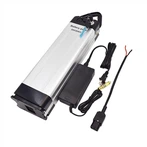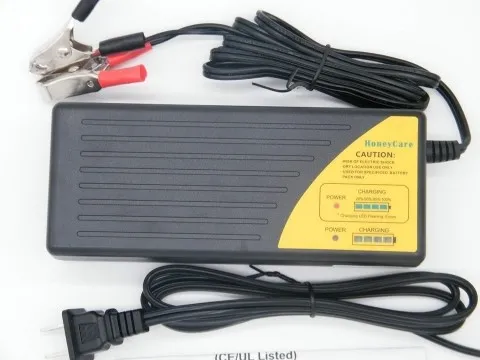
Choosing a suitable electric bicycle battery charger is not only to improve the charging efficiency, but also for the safety of the battery. Poor quality and non-compliant chargers can lead to many problems, including overheating, short-circuiting and even spontaneous combustion of the battery, which can cause a fire. With so many options on the market, it's vital to know how to choose a safe battery charger to protect your battery and most importantly your life and the lives of others.
Certification and standards
Look for battery chargers with UL, CE, and FCC certifications. These certifications ensure that the charger meets specific safety and performance standards. Certified chargers undergo rigorous safety and efficiency testing and are a reliable choice. UL, CE, FCC and other certification marks are usually printed on the shell, label or plug of the charger. These marks are generally issued by certification bodies and have unique symbols and numbers. Or you can look at the box or manual, consult the official website or technical specifications of the product, check the authenticity of the certification number or logo, and so on
Underwriters Laboratories (UL) : This is a certification in the United States, and the logo is usually a circle with the word "UL" to indicate that the product meets safety and performance standards. The logo is usually accompanied by a certification number. You can visit UL's official website and enter the certification number to verify that the product is certified. The official website will display the product, manufacturer, model and other information.
CE (Conformite Europeenne) : This is the certification mark required for a product to be sold in the European Union (EU). The CE mark is a mark with the word "CE". The CE mark itself does not have a number, but by checking whether there is an authorized body (such as TUV, SGS) number represented by the EC, you can better confirm the authenticity of the certification of the product.
FCC (Federal Communications Commission) : This is the electromagnetic compatibility certification in the United States, and the logo is usually the word "FCC", indicating that the product will not cause interference with other electronic devices. You can access the FCC's official database for certification information through the FCC ID number (usually marked on the product label) to ensure that the product has passed FCC testing.
Charging speed and current
The charging speed can significantly affect the overall health of the battery. A charger with too high a current can cause the battery to overheat, while a charger with too low a current can be inefficient. A good charger balances speed and safety, ideally providing adjustable current Settings to meet the needs of different types of batteries. Some simple ways to help you determine the right charging speed and current:
1. View the battery specifications and recommended parameters
First, consumers should check the label or instruction manual on the e-bike battery to find the rated voltage and capacity of the battery (usually indicated by "V" and "Ah"). According to these parameters, the appropriate charging current can be calculated. For example, if the battery is 36V, 10Ah, then the ideal charging current should be between 2-5A, and the charging time is about 2-5 hours.
2. Select the charging current based on the battery capacity
The charging current (in amps A) should not normally exceed 50% of the battery capacity. For example, for a 10Ah battery, the appropriate charging current should be below 5A. If you choose a larger current, although the charging speed will be faster, it will also increase the risk of battery heating and accelerate the aging of the battery.
3. Check the output parameters of the charger
Before purchasing, carefully review the Output parameters on the charger label, especially the "output" item, to ensure that its voltage and current match the battery needs. For example, a charger with an output of "42V 2A" is suitable for a 36V battery (the charger voltage is usually slightly higher than the battery voltage). The output current determines the charging speed, and the 2A charger will charge more slowly than the 4A charger, but it is also safer.

E-bike battery and charger compatibility
Make sure the charger is compatible with the type of battery you're using, whether it's lithium-ion, nickel-metal Hydride, or something else. Using a charger that is not compatible with your battery type can result in inefficient charging or even damage to the battery. Specifically, the battery voltage and charger voltage mismatch, the charger current output is inappropriate, the interface design is inconsistent, or the charger protection mechanism is incompatible with the battery, can lead to overcharge, overheating, or even damage to the battery, usually due to the charger current output is too high, resulting in an increase in the internal impedance of the battery, unable to effectively dissipate heat, resulting in a rise in battery temperature. In addition, incompatible chargers may reduce charging efficiency and increase safety hazards, such as battery expansion or spontaneous combustion. Therefore, to ensure safety and performance, it is recommended to always use a charger that matches the battery specifications. The output parameters are usually written clearly in the specification of the charger.
Intelligent charging technology
Modern chargers are equipped with smart charging technology to prevent overcharging, overheating and short circuits. Features such as automatic battery shutdown when fully charged, temperature control, and surge protection are essential to a safe charger and provide an extra layer of security.
1. Automatic shutdown function
When the battery is fully charged, the smart charger will automatically stop charging. This is achieved through the built-in charge management system, which monitors the charging status of the battery in real time. When the battery level reaches the preset maximum, the charger will automatically disconnect the power supply to prevent further charging, thereby avoiding overcharging problems. This not only protects the battery life, but also reduces the risk of overheating.
2. Temperature control
The smart charger is equipped with a temperature sensor to monitor the temperature during charging in real time. If the temperature is detected to exceed the safe range, the charger will adjust the charging rate or stop charging completely to prevent the battery from overheating. This temperature control function prevents safety hazards caused by overheating of the battery, such as battery expansion, leakage, or spontaneous combustion.
3. Surge protection
The surge protection function prevents the battery from being affected by sudden voltage changes during charging. The charger will monitor the power supply voltage and automatically adjust or disconnect the power supply when it detects voltage fluctuations or surges to protect the battery from voltage shocks. This can avoid battery damage or charger failure due to power surges.
4. Overcharge protection
Modern chargers also have an overcharge protection mechanism. The mechanism continuously monitors the battery's power level and charging status to ensure that the charging process is strictly controlled within a safe range. If the charger detects any abnormality, the system will take timely measures, such as reducing the charging current or disconnecting the power supply, so as to effectively prevent the occurrence of overcharging.
5. Short circuit protection
The smart charger is also equipped with short circuit protection. During the charging process, if a short circuit occurs, the charger will immediately cut off the power supply to prevent excessive current caused by short circuit from causing damage to the battery and charger. This helps ensure the stability and safety of the charging process.
6. Constant current and constant voltage charging
This technology enables the charger to provide a constant current at the beginning of the charge, and when the battery is near full load, it switches to a constant voltage mode. This charging mode optimizes charging efficiency, reduces the impact on the battery, and helps to extend battery life.

Charger quality and brand reputation
Not all chargers are created equal. Choose a well-known e-bike brand with good quality and reputation such as Specialized, Trek or Giant. These brands often have better manufacturing quality and include more safety features, and the chargers they configure for e-bikes are also original quality, more compatible and protective, while cheap universal chargers may lack these features. Generally not necessary, it is recommended to use the original charger of the electric bicycle manufacturer or the charger recommended by the manufacturer.