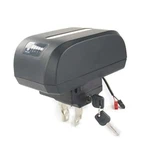
The BMS is often hidden inside the battery case, but it controls many of the problems customers notice first: sudden power cut-off, charging failure, overheating, short cycle life, and inconsistent performance between packs. A low-cost battery with a weak BMS can quickly become an expensive after-sales problem.
For OEM buyers, BMS selection should not be left as a vague supplier decision. It should be part of the RFQ, sample test, quality inspection, and warranty agreement. The right BMS depends on controller current, cell chemistry, battery configuration, temperature environment, and whether communication with the bike system is required.
Quick Answer: An e-bike battery BMS should match the pack voltage, cell chemistry, controller current, peak current, charging current, temperature range, and communication needs. At minimum, buyers should confirm overcharge, over-discharge, over-current, short-circuit, temperature protection, cell balancing, and traceable BMS specifications before sample approval.
Key Takeaways for B2B Buyers
- BMS current rating must be checked against controller current, not only motor wattage.
- Temperature sensing and cell balancing are important for reliability and cycle life.
- Communication BMS requirements should be confirmed early for smart or proprietary systems.
- The BMS specification should appear in the quotation, sample record, and bulk inspection checklist.
Buyer Decision Snapshot
| BMS Requirement | Buyer Question | Risk If Ignored |
|---|---|---|
| Continuous current | Does it support the controller current with margin? | Power cut-off, heat, short BMS life. |
| Peak current | How long can peak current be supported? | Failure under acceleration or climbing. |
| Temperature protection | How many sensors and where are they placed? | Unsafe charging/discharging conditions. |
| Cell balancing | Is balancing included and at what stage? | Capacity drift and shorter service life. |
| Communication | Is CAN, UART, SMBus, or custom protocol needed? | Display errors or system lockout. |
Recommended Reading Path: BMS decisions should connect to cell selection and sample testing. For a supplier background check, review GEB company profile and then request a BMS engineering review for your project.
Start With Motor and Controller Requirements
The BMS current rating should be selected according to the motor, controller, and usage profile. Buyers often say "the motor is 500W" and assume that is enough information. It is not. The controller current tells the battery how much current may be demanded during acceleration and hill climbing. A 500W bike with a conservative controller may need a different BMS than a 500W bike tuned for strong acceleration.
When requesting a BMS recommendation, provide motor power, controller current, peak current behavior, riding terrain, rider load, and whether the bike is used for commuting, cargo, delivery, rental, or performance riding. This allows the supplier to choose a standard current, continuous current, and peak current margin that fits real use.
Important current terms
- Standard discharge current: normal working current for typical riding.
- Maximum continuous current: current the pack can support for longer periods under defined conditions.
- Peak current: short-duration current during acceleration or high load.
- Charge current: standard, fast, and maximum charging limits.
- Current margin: safety buffer between controller demand and BMS limit.
Core Protection Functions Every Buyer Should Check
A basic e-bike battery BMS should protect against common electrical risks. These protections help prevent cell damage, overheating, unsafe discharge, and short-circuit events. Buyers should not only ask whether the BMS has protections; they should ask for the protection values, test method, and whether the supplier checks these functions during production.
The exact settings depend on voltage, chemistry, cell type, and application. For example, a 10S lithium-ion pack and a 13S lithium-ion pack require different voltage thresholds. LFP systems use different voltage behavior again. This is why the BMS must match the chemistry and configuration.
Protection functions to request
- Overcharge protection.
- Over-discharge protection.
- Over-current protection.
- Short-circuit protection.
- Charge and discharge temperature protection.
- Cell balancing.
- Reverse polarity or charger error protection where applicable.
Temperature Monitoring and Thermal Risk
Temperature is a practical issue in e-bike batteries because packs may be used in summer heat, winter cold, steep hills, delivery routes, and repeated fast charging. A BMS should monitor temperature and stop charge or discharge when the battery moves outside safe limits. This protects both the battery and the user.
For B2B buyers, ask how many temperature sensors are used, where they are placed, and what the cutoff values are. In larger packs or higher-current applications, sensor placement matters. A sensor located far from the heat source may react too slowly. A better design considers cell layout, nickel strip path, BMS location, and housing ventilation or sealing.
Cell Balancing and Long-Term Capacity Retention
Cell balancing helps keep cell groups at similar voltage levels over time. Without balancing, one group may reach overcharge or over-discharge limits earlier than others, reducing usable capacity and triggering earlier cutoff. For daily-use batteries, cell balancing supports long-term consistency and better service life.
Buyers should ask whether the BMS includes balancing, when balancing starts, and what balancing current is used. Also ask whether the supplier performs OCV sorting and cell matching before assembly. Balancing is helpful, but it cannot fully correct poor cell matching. Good pack quality begins before the BMS is installed.
Smart BMS and Communication Needs
Some e-bike battery projects require communication between the battery, display, controller, charger, or app. This may include CAN, UART, SMBus, or custom protocols depending on the system. Communication can support battery percentage display, error codes, cycle count, anti-theft functions, or fleet monitoring.
However, smart communication also increases project complexity. Buyers should confirm whether the bike system is open or proprietary, whether the protocol is available, and whether the supplier can support software matching. For replacement batteries, communication compatibility is often the most difficult part. A physically similar battery may still fail if the protocol does not match.
When smart BMS may be useful
- Fleet management and rental operations.
- High-end e-bikes with advanced displays.
- Battery health monitoring for distributors.
- Systems requiring communication with charger or controller.
- Projects needing cycle count and warranty data.
Production Testing Is as Important as BMS Selection
Choosing a good BMS design is only the first step. The supplier must also test each pack during production. This includes voltage check, protection function check, charge and discharge check, aging test, and sometimes communication test. A BMS that is correct in theory but not verified in production can still create inconsistent results.
Ask the supplier what test equipment is used, what data is recorded, and whether each battery receives a serial number. For distributors, traceability is valuable because it helps identify production batches and investigate after-sales issues. For brands, test records protect the product reputation.
Supplier Questions That Reveal BMS Engineering Capability
A professional supplier should be able to answer practical BMS questions without hiding behind vague statements. Buyers can ask how the BMS rating was selected, what safety margin exists between controller current and protection cutoff, whether the BMS has been used in similar projects, and how the factory tests protection functions before shipment. The answers often reveal whether the supplier is engineering-driven or only assembling standard packs.
For higher-value OEM projects, buyers should also ask whether alternative BMS versions are available. For example, a commuter battery may use a simple reliable BMS, while a fleet battery may need communication, cycle data, fault codes, or stronger temperature monitoring. Defining these options early helps the buyer build a product roadmap instead of changing suppliers for every new model.
BMS review checklist for procurement teams
- Confirm continuous and peak current ratings against the controller.
- Request charge and discharge protection thresholds.
- Ask where temperature sensors are placed inside the pack.
- Confirm whether balancing is included and tested.
- Check whether smart communication is required or optional.
- Ask for sample test records before approving mass production.
Questions to Ask About BMS Design
- What is the BMS continuous discharge current and peak current?
- Does the BMS match the chemistry and series count of the pack?
- Where are temperature sensors located?
- Is communication required with the bike display or controller?
- Can the supplier provide BMS specification and production consistency records?
Procurement Tip: If a supplier answers these questions clearly, the project is usually easier to sample, inspect, and repeat. If the answers stay vague, treat the quotation as preliminary rather than final.
Conclusion
For OEM buyers, the BMS should never be treated as a generic accessory. It directly affects current output, safety protection, temperature control, cycle life, compatibility, and warranty risk. A strong e-bike battery project defines BMS requirements at the RFQ stage, verifies them during sampling, and confirms them again during production testing.
Defining BMS requirements for an OEM e-bike battery? Contact GEB with your controller current, motor power, battery voltage, chemistry preference, and communication needs for engineering support.
FAQ
Can I use a higher-current BMS for every project?
Not always. A higher-current BMS may increase cost and size. The correct choice depends on controller demand, cell capability, thermal design, and application.
Does a smart BMS make the battery better?
A smart BMS adds monitoring and communication functions, but it also requires system compatibility. For some simple applications, a well-designed standard BMS is more practical.
What BMS information should be included in a quotation?
The quotation should include continuous current, peak current, charge current, protection functions, temperature monitoring, balancing, communication functions, and test standards.
Can I use a higher-rated BMS to make the battery safer?
A higher current rating can provide margin, but it is not automatically better. The BMS must match the cells, wiring, connector, thermal design, charger, and application. Over-specifying one part while ignoring the full pack design can create new risks.