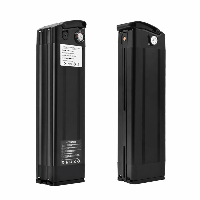
Choosing an e-bike battery supplier in China is not only a price decision. For brands, distributors, repair chains, and importers, the battery is the most sensitive component in the entire e-bike system. It affects range, safety, charging performance, warranty cost, customer reviews, and even whether your product can enter a target market smoothly.
Many buyers start by asking one simple question: "What is your price for 36V or 48V e-bike batteries?" That question is understandable, but it is not enough. Two suppliers can quote the same capacity and voltage while using different cells, BMS designs, welding processes, housings, chargers, test standards, and after-sales policies. The cheaper quote may become expensive later if it causes return claims, shipping problems, or compatibility failures.

This guide explains how to evaluate an e-bike battery supplier from a procurement perspective. The goal is not to find the lowest factory price, but to find a supplier that can support your business for repeated orders.
Start With Your Application, Not the Supplier Catalog
Before comparing suppliers, define your application clearly. A good battery supplier cannot recommend the right pack if the buyer only says "48V battery" or "rear rack battery." You should prepare the key information first:
- Motor rated power and peak power
- Nominal voltage, such as 36V, 48V, 52V, 60V, or 72V
- Required capacity in Ah or Wh
- Installation type, such as downtube, rear rack, triangle, bottle, integrated, or custom case
- Connector type and discharge plug
- Charger voltage and charging current
- Waterproof requirement
- Target market and certification needs
- Expected monthly or annual quantity
- Warranty expectation
For example, a 48V 20Ah battery for a city commuter e-bike and a 48V 20Ah battery for a cargo e-bike may look similar on paper. In reality, the cargo bike may need higher peak current, stronger mounting, better heat management, and a more conservative BMS setting.
A reliable supplier will ask questions before quoting. If a factory gives a final price without asking about motor power, discharge current, cells, case type, certification, or shipping method, treat it as an early warning sign.
Check Whether the Supplier Understands Battery Engineering
A professional e-bike battery manufacturer should be able to explain the relationship between voltage, capacity, current, BMS, cells, and range. They should not only repeat catalog data.
Important technical questions include:
- What cell brand and cell model will be used?
- Is the pack built with 18650, 21700, pouch, or prismatic cells?
- What is the continuous discharge current?
- What is the peak discharge current and how long can it last?
- What protections are included in the BMS?
- How is cell balancing handled?
- How is the pack tested before shipment?
- Can the supplier provide the battery pack drawing?
- Can the supplier customize the case, connector, cable length, label, or communication protocol?
The supplier does not need to give you every internal design secret, but they should explain the logic clearly. For B2B buyers, technical communication is part of risk control.
Evaluate the BMS Carefully
The Battery Management System is one of the most important parts of an e-bike battery pack. Good cells with a weak BMS can still become an unreliable battery.
A suitable BMS should include protection against overcharge, over-discharge, over-current, short circuit, temperature issues, and cell imbalance. For higher-power e-bikes, cargo bikes, or fleet applications, the BMS should be selected according to real load conditions, not just the nominal motor wattage.
For OEM projects, ask whether the BMS can support communication features, such as CAN, UART, SMBus, Bluetooth, or customized data output. Not every project needs a smart BMS, but the supplier should know when it is necessary and when a standard BMS is enough.
Confirm Certifications and Market Requirements
Related guide: What Certifications Do E-Bike Batteries Need for the US and EU Markets?
If your target market is Europe, North America, the UK, Australia, or other regulated markets, certification must be discussed early. Certifications are not decorations for a product page. They affect customs clearance, platform approval, insurance, and customer trust.
Common documents may include UN38.3 for transportation, MSDS, CE, RoHS, IEC-related testing, and market-specific safety documents. For some e-bike systems or sales channels, UL-related standards may be requested.
A common mistake is asking for certificates after mass production has already started. If certification is required, battery structure, cell selection, charger, labeling, manual, and packaging may all need to match the test file. Changing parts after testing can make a certificate less useful.
Always ask for the certificate holder name, product model, test standard, test report, and whether the tested product matches your planned order.
Understand the Supplier's Quality Control Process

Quality control is where many low-cost batteries fail. A professional supplier should have clear inspection steps for incoming cells, cell sorting, welding, BMS assembly, aging test, charging and discharging test, appearance inspection, labeling, and packaging.
Ask about:
- Cell voltage and internal resistance sorting
- Nickel strip thickness and welding method
- Insulation design and vibration protection
- Aging test duration
- OCV test before shipment
- Random sample inspection
- Traceability system
- Warranty claim handling
Traceability is especially important for distributors. If a field failure happens, you need to know which batch, which cell lot, and which production date are involved. Without traceability, after-sales problems become arguments instead of solutions.
Do Not Judge by MOQ Alone
MOQ matters, but it should not be the only factor. A very low MOQ may sound attractive for trial orders, but some customized projects require tooling, special cases, custom BMS programming, or dedicated labels. In those cases, the MOQ may be higher for a valid reason.
A good supplier usually supports a staged approach:
- Technical confirmation and quotation
- Sample order
- Sample testing and feedback
- Small batch trial order
- Stable mass production
- Long-term supply agreement
This process protects both sides. The buyer avoids ordering too much before validation, and the manufacturer avoids unstable custom requests without clear specifications.
Compare Total Cost, Not Only Unit Price
Related guide: How to Compare E-Bike Battery Quotations.
Battery procurement cost includes more than the quoted unit price. You should consider the cell grade, BMS quality, charger, packaging, certification cost, shipping method, warranty reserve, return rate, communication efficiency, and replacement support.
A battery that costs a few dollars less may not be cheaper if it has a higher failure rate. For e-bike brands, battery failure can damage the whole product reputation. For distributors, it can consume margin through returns, replacement shipping, and customer service time.
The correct question is not "Which supplier is the cheapest?" The better question is: "Which supplier gives the best balance of safety, performance, compliance, delivery, support, and price?"
Red Flags When Choosing a Supplier
Be careful if a supplier:
- Quotes immediately without asking technical details
- Cannot explain BMS settings
- Uses vague words like "high-quality cells" without naming cell type or grade
- Refuses to provide test reports or sample test data
- Promises unrealistic delivery time for custom packs
- Offers suspiciously low prices compared with the market
- Cannot provide drawings or packing details
- Avoids warranty terms
- Has no clear process for sample modification
These signs do not always prove the supplier is bad, but they mean you should slow down and verify more.
Why Work With an Experienced OEM/ODM Battery Manufacturer
For e-bike brands and distributors, working with an experienced OEM/ODM battery manufacturer can reduce product development risk. A real manufacturer can help adjust voltage, capacity, dimensions, connectors, BMS current, case design, labels, packaging, and production testing according to the target application.
GEB provides custom e-bike battery solutions for international B2B customers, including lithium-ion battery packs, replacement batteries, and OEM/ODM battery designs. For buyers who need stable supply, technical communication, and flexible customization, GEB can support sample development, bulk purchasing, and long-term cooperation.
Choosing the right e-bike battery supplier starts with confirming the technical details before sampling. If you need support reviewing voltage, capacity, BMS design, certification standards, or order quantity, GEB can provide a free technical review. Contact us here: https://www.gebbattery.com/contact-us
FAQ
What information should I send before asking for a quotation?
Send voltage, capacity, motor power, installation type, battery dimensions, connector, discharge current, target market, required certifications, and estimated quantity. Photos or drawings of the existing battery are also helpful.
Is the lowest battery quote usually the best choice?
No. A low price may come from lower-grade cells, weaker BMS, fewer tests, cheaper housing, or limited warranty support. For B2B orders, total cost and failure risk are more important than the first unit price.
Should I order samples before bulk purchasing?
Yes. Samples help verify compatibility, range, charging, mounting, communication, appearance, and user experience. Bulk production should begin only after sample approval.
Can GEB customize e-bike batteries for my brand?
Yes. GEB supports OEM/ODM e-bike battery customization, including voltage, capacity, case style, connector, BMS, label, and packaging options for B2B customers.