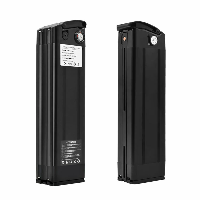
MOQ is one of the first questions B2B buyers ask when sourcing e-bike batteries. It is also one of the most misunderstood. Many buyers want a small minimum order quantity because they need to test the market, reduce inventory pressure, or validate a new product. Manufacturers, on the other hand, must consider cell purchasing, BMS configuration, case availability, labor setup, label printing, packaging, testing, and production efficiency.
A realistic MOQ is not simply a sales rule. It is connected to the battery design and supply chain. Understanding how MOQ works helps buyers negotiate better and plan orders more safely.
What Does MOQ Mean in E-Bike Battery Procurement?
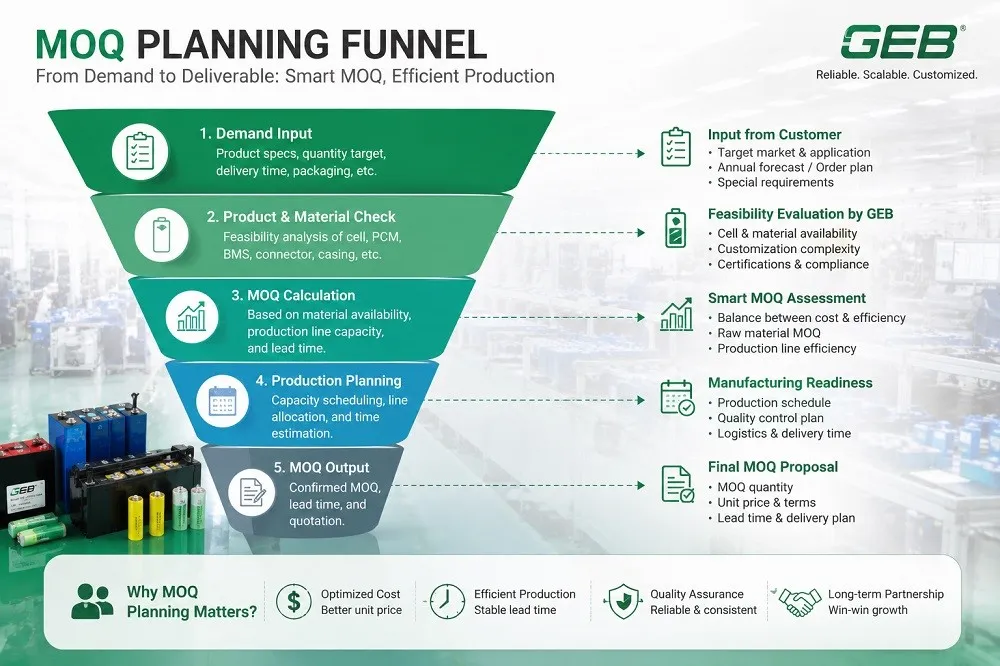
MOQ means Minimum Order Quantity. It is the smallest quantity a supplier is willing to produce or sell under a certain condition. In e-bike battery sourcing, MOQ can vary widely depending on whether the battery is a standard model, a semi-custom model, or a fully customized battery pack.
A standard replacement battery may have a lower MOQ because the case, BMS, connector, and production process already exist. A fully customized battery with new dimensions, special communication, private label packaging, or new tooling will usually require a higher MOQ.
The key is to understand what is included in the MOQ. A quote for 100 pieces of a standard downtube battery is very different from 100 pieces of a new integrated battery designed for a private frame.
Why Battery MOQ Is Different From Simple Consumer Products
An e-bike battery is not like a plastic accessory or a generic cable. It contains lithium cells, BMS, insulation materials, nickel strips, wires, connectors, housing parts, charger compatibility, labels, cartons, and safety documents. Each of these parts has its own purchasing and production constraints.
For example, if your project requires a special connector, the connector supplier may also have a minimum order. If you need a custom case color, the plastic case factory may need a minimum painting or molding quantity. If you want a private label, the label and packaging supplier may set a printing MOQ.
Cell supply can also affect MOQ. If you request a specific cell model, the battery manufacturer must check whether it is available in small quantities. Premium cells are often purchased by batch, and cell matching requires enough cells to sort voltage and internal resistance properly.
Sample MOQ vs Trial Order MOQ vs Mass Production MOQ
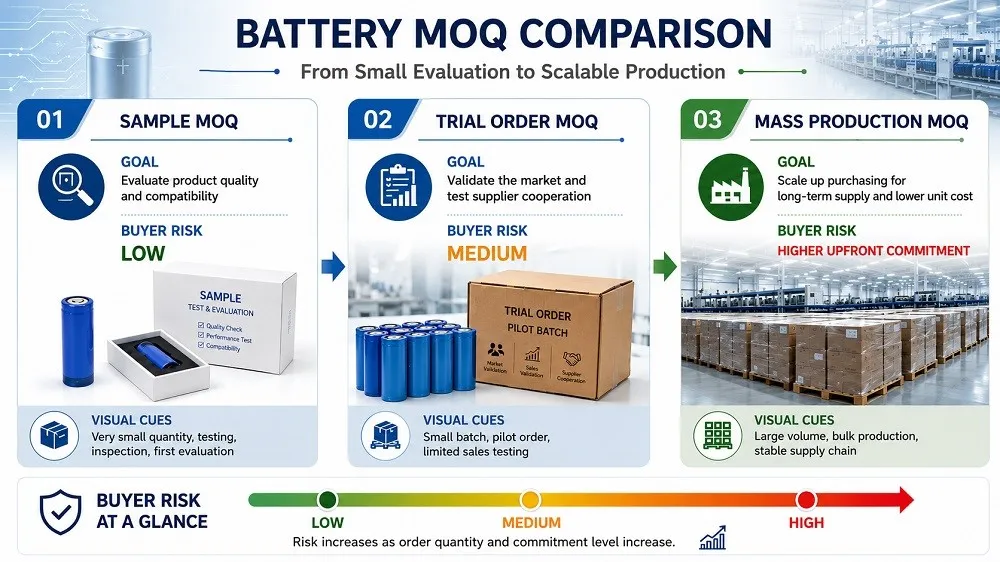
Buyers should separate MOQ into three stages.
Sample Stage
The sample stage is for technical validation. The purpose is to confirm electrical performance, mechanical fit, connector compatibility, charging behavior, and appearance. Sample prices are usually higher than mass production prices because setup time and labor are not spread across a large quantity.
For standard models, one to several samples may be possible. For custom models, sample development may require engineering fees, material fees, or tooling fees.
Trial Order Stage
A trial order is larger than samples but smaller than full mass production. It helps buyers test market response, check real customer feedback, and verify logistics and after-sales issues. Trial orders are useful for new distributors or brands launching a new e-bike model.
Mass Production Stage
Mass production is where the price becomes more stable. The supplier can purchase materials more efficiently, schedule production better, and reduce per-unit labor cost. This is also where consistent quality control and batch traceability become more important.
Common Factors That Affect E-Bike Battery MOQ
Several factors can raise or lower MOQ:
- Standard model or custom design
- Cell type and cell brand
- Battery case availability
- BMS current and communication function
- Connector and cable customization
- Label and packaging requirements
- Certification requirement
- Charger included or not
- Shipping method and battery packaging
- Monthly forecast and long-term cooperation plan
If your project uses an existing case, common voltage, standard BMS, and regular connector, MOQ can usually be more flexible. If your project requires a new case, new mold, smart BMS, app function, special certification, or exclusive packaging, expect a higher MOQ.
How Buyers Can Reduce MOQ Pressure
Related guide: How to Choose an E-Bike Battery Supplier in China.
You may not always be able to force a lower MOQ, but you can reduce the risk of MOQ in several ways.
First, choose an existing battery platform when possible. If the supplier already has a suitable downtube, rear rack, triangle, or bottle battery platform, you can customize capacity, connector, label, and packaging without creating everything from zero.
Second, divide the project into stages. Start with samples, then a small trial order, then bulk production. This lets you test real market demand before committing to a large order.
Third, provide a forecast. If you can show a realistic monthly or quarterly purchasing plan, a supplier may be more willing to support a smaller first order.
Fourth, avoid unnecessary customization. Many buyers request custom colors, unique packaging, and special stickers before the product is even tested. It is often better to validate the battery performance first, then improve branding for the second batch.
When a Low MOQ Can Be Risky
A very low MOQ sounds attractive, but it can also create hidden risks. If a supplier accepts any small quantity for a custom battery without engineering review, they may be assembling parts manually without stable production control. Small batches are not automatically bad, but the supplier should still follow consistent cell sorting, welding, insulation, BMS testing, aging, and final inspection.
Buyers should ask whether the sample and mass production units use the same cells, same BMS, same charger, same case, and same test process. A sample that performs well but differs from mass production is not useful.
How to Discuss MOQ With a Battery Manufacturer
Instead of asking only "What is your MOQ?" ask more detailed questions:
- What is the MOQ for your standard model?
- What is the MOQ if I need my own logo?
- What is the MOQ if I change the connector?
- What is the MOQ if I need a custom case?
- Is there a sample fee or engineering fee?
- Can the sample cost be refunded after bulk order?
- Can we start with a trial order before mass production?
- What parts drive the MOQ?
These questions show that you understand procurement logic. They also help the supplier give a more accurate answer.
Practical MOQ Planning for B2B Buyers
Related guide: E-Bike Battery Lead Time.
For a new product, a smart procurement plan may look like this:
- Send technical requirements and target market
- Select one or two supplier platforms
- Order samples for performance and fit testing
- Test samples under real riding conditions
- Adjust connector, label, BMS, or case details if needed
- Place a trial order for market validation
- Collect customer feedback and warranty data
- Move to regular bulk purchasing
This approach is slower than ordering a full container immediately, but it reduces the chance of costly mistakes.
How GEB Supports Sample and Bulk Orders
GEB supports B2B buyers with flexible e-bike battery development, including standard models, semi-custom projects, and OEM/ODM battery pack solutions. Depending on the project, GEB can help buyers plan samples, trial orders, and mass production based on voltage, capacity, case type, BMS current, connector, label, packaging, and certification needs.
For distributors and e-bike brands, the best MOQ is not always the lowest MOQ. The best MOQ is the quantity that allows proper testing, stable quality, and profitable long-term supply.
When planning e-bike battery samples, trial orders, or your first bulk purchase, it's important to align MOQ with your technical specifications and expected monthly demand. GEB can help review your target voltage, capacity, battery design, and forecast to create a staged MOQ plan for your project. Contact GEB here: https://www.gebbattery.com/contact-us
FAQ
Why is the sample price higher than the bulk price?
Samples require engineering communication, small-batch material preparation, manual setup, and testing. These costs are not spread across a large production quantity, so the unit price is usually higher.
Can I put my logo on a small order?
Sometimes yes, especially with stickers or simple labels. Custom printed cases or packaging may require a higher MOQ because printing suppliers have their own minimum quantity.
Should I choose a supplier only because they offer the lowest MOQ?
No. Low MOQ is helpful, but quality control, BMS design, cell selection, certification, warranty, and delivery reliability matter more for long-term procurement.
Can GEB help with both samples and mass production?
Yes. GEB can support sample development, trial orders, and bulk purchasing for e-bike battery projects, depending on the technical requirements and customization level.