When sourcing e-bike batteries, many buyers receive quotations that look similar at first glance. The voltage may be the same. The capacity may be the same. The case may look similar. Yet the price difference can be large. One supplier may quote a very low price, another may quote a moderate price, and a third may be much higher.
The question is: which quotation is actually better?
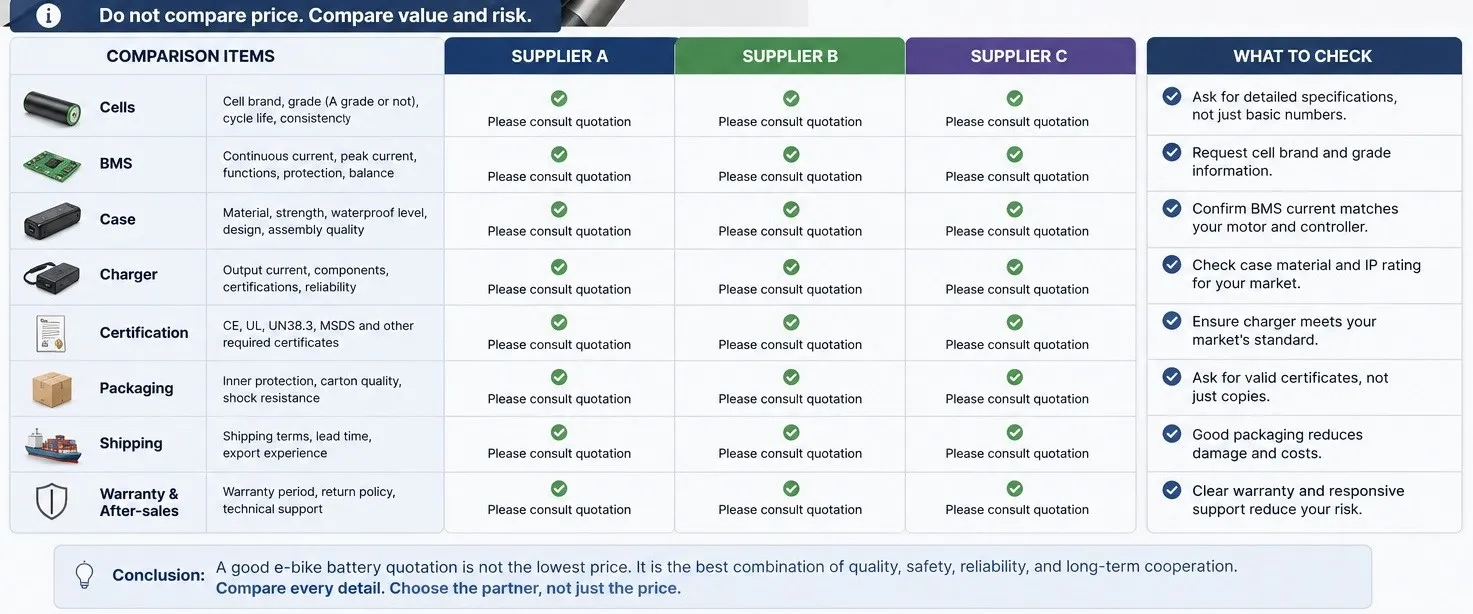
For B2B procurement, comparing only the unit price is risky. An e-bike battery quotation includes many hidden decisions: cell grade, BMS current, welding quality, case material, charger quality, certification, packaging, warranty, after-sales service, and production testing. A low price can be a real advantage if the quality is controlled. It can also be a warning sign if key components are being reduced.
This article explains how to compare e-bike battery quotations in a practical way.
First, Make Sure You Are Comparing the Same Specification
Related guide: How to Choose an E-Bike Battery Supplier in China.
Before judging price, confirm whether all suppliers are quoting the same battery specification. Many quotation differences come from unclear requirements.
Check these basic items:
- Nominal voltage
- Capacity in Ah and Wh
- Cell type, such as 18650 or 21700
- Cell brand and model
- Battery configuration
- Continuous discharge current
- Peak discharge current
- BMS protection functions
- Case type and material
- Connector and cable length
- Charger included or not
- Label and packaging
- Certification documents
- Warranty period
- Shipping terms
For example, a 48V 20Ah battery can be built with different cells and BMS designs. One pack may use lower-cost cells with a basic BMS, while another uses premium cells, stronger discharge capability, better insulation, and a more complete test process. Both may be called "48V 20Ah," but they are not the same product.
Compare Watt-Hours, Not Only Amp-Hours
Many buyers compare batteries by Ah, but Wh is often more useful. Watt-hours show the actual energy capacity of the pack.
The formula is:
Wh = Voltage x Ah
A 36V 20Ah battery is about 720Wh. A 48V 20Ah battery is about 960Wh. If two suppliers quote different voltages, Ah alone can mislead you.
For procurement, always ask suppliers to list both Ah and Wh. This makes capacity comparison more accurate and helps you explain product value to your customers.
Cell Cost Is a Major Price Driver
Cells are usually one of the biggest cost components in an e-bike battery pack. Different cell brands, models, and grades can change the price significantly.
Ask the supplier:
- Which cell brand is used?
- What is the exact cell model?
- Is it original grade A cell?
- Can you provide cell specifications?
- How are cells sorted before assembly?
- Can the same cell be used in mass production?
Some suppliers may use vague phrases like "imported cells" or "high-quality cells." That is not enough for a professional quotation. You need a clear cell model because cell discharge rate, cycle life, energy density, and cost can differ widely.
Do not assume that a famous cell brand automatically means a good battery pack. Pack design, BMS, welding, and testing still matter. But without knowing the cell source, you cannot compare quotations seriously.
BMS Quality Changes Both Cost and Reliability
The BMS is another key price factor. A basic BMS for a low-power commuter battery is not the same as a higher-current BMS for a cargo bike or mountain e-bike.
Important BMS details include:
- Continuous discharge current
- Peak current
- Charging current
- Overcharge protection
- Over-discharge protection
- Short-circuit protection
- Temperature protection
- Cell balancing
- Communication function
- Bluetooth or app function if needed
If one supplier quotes a 30A BMS and another quotes a 15A BMS, the price difference may be reasonable. But if your e-bike motor requires higher current, the cheaper BMS may cause cut-off, overheating, or shortened lifespan.
Look at the Testing Process
Testing adds cost, but it also reduces warranty risk. A serious e-bike battery quotation should include quality control steps.
Ask whether the supplier performs:
- Cell voltage and internal resistance sorting
- Spot welding inspection
- BMS function test
- Charge and discharge test
- Aging test
- OCV test before shipment
- Appearance inspection
- Packing drop or vibration-related checks where applicable
If a quotation is very cheap, ask what tests are included. Sometimes low cost comes from reducing testing time. That may not matter in the first shipment, but it can become expensive when returns start.
Certifications and Documents Are Not Free
Related guide: E-Bike Battery Certifications for US and EU Markets.
If your target market requires certificates or safety documents, include them in the quotation comparison. Some suppliers quote a low battery price but do not include valid documents. Later, the buyer may need to pay extra for testing, reports, or corrected labels.
Common documents may include UN38.3, MSDS, CE, RoHS, and other safety or transportation files. For some markets and channels, more advanced safety standards may be requested.
Ask whether the quotation includes:
- Existing certificates
- Test reports matching the model
- Shipping documents
- Battery warning label
- Carton label
- User manual
- Charger certificates
A certificate that does not match the product model, voltage, capacity, or factory name may not help you much.
Warranty Terms Affect Real Cost
Related guide: How to Build a Reliable E-Bike Battery Supply Chain.
A quotation should not be judged without warranty details. A supplier offering a slightly higher unit price but a clear warranty policy may be better than a cheaper supplier with unclear responsibility.
Clarify:
- Warranty period
- What failures are covered
- What failures are not covered
- How defects are verified
- Whether replacement parts are provided
- Whether the supplier offers credit, repair, or replacement
- How batch problems are handled
For distributors, warranty cost can decide profit. If the battery return rate is high, your margin disappears quickly.
Packaging and Shipping Can Change the Final Price
Lithium batteries require proper packaging and shipping procedures. Do not compare only EXW factory price unless you understand logistics.
Ask whether the price includes:
- Individual carton
- Foam or protective packaging
- Dangerous goods packaging where needed
- Pallet packing
- Shipping mark
- Required battery labels
- Charger and accessories
Also compare Incoterms such as EXW, FOB, CIF, DDP, or door-to-door service. A low EXW price may become expensive if the buyer must arrange complicated battery shipping alone.
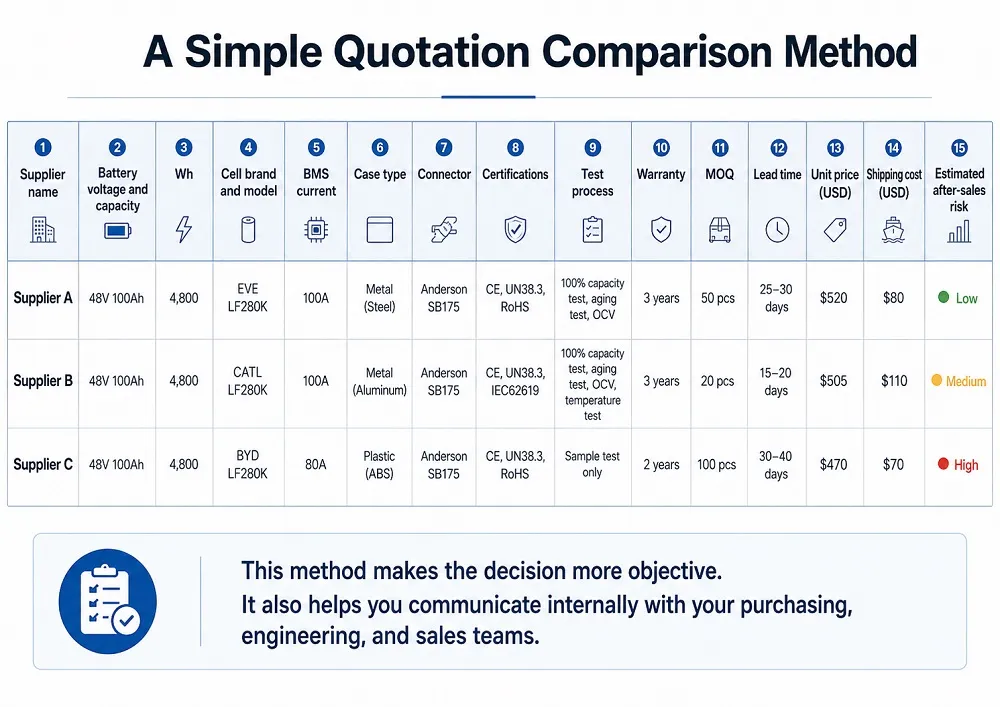
A Simple Quotation Comparison Method
Create a comparison sheet with these columns:
- Supplier name
- Battery voltage and capacity
- Wh
- Cell brand and model
- BMS current
- Case type
- Connector
- Certifications
- Test process
- Warranty
- MOQ
- Lead time
- Unit price
- Shipping cost
- Estimated after-sales risk
This method makes the decision more objective. It also helps you communicate internally with your purchasing, engineering, and sales teams.
Why a Professional Quotation Should Explain the Value
A good battery supplier should not only send a number. They should explain why the battery costs what it costs. If the quotation is higher, they should explain the value: better cells, stronger BMS, improved testing, safer packaging, customization, certifications, or warranty support.
GEB supports B2B buyers with detailed e-bike battery quotations based on real specifications. Instead of quoting only by voltage and capacity, GEB can help buyers match battery design with motor power, application, target market, certification needs, and order plan.
When comparing quotes from different e-bike battery suppliers, make sure each offer is based on the same voltage, capacity, cell type, BMS design, certification requirements, and order quantity. GEB can provide a specification-based quotation with a clearer cost breakdown to help you evaluate your options more accurately. Contact GEB here: https://www.gebbattery.com/contact-us
FAQ
Why do two suppliers quote very different prices for the same 48V 20Ah battery?
Because the cell model, BMS current, case quality, testing process, certification, warranty, and packaging may be different. The same voltage and Ah do not guarantee the same quality.
Should I ask for the exact cell model?
Yes. Cell model is essential for comparing energy density, discharge capability, cycle life, and cost. Vague cell descriptions are not enough for B2B procurement.
Is a higher price always better?
No. A higher price must be supported by clear specifications, stronger components, better testing, valid certifications, or better service. Buyers should compare value, not price alone.
Can GEB provide quotation support for custom e-bike battery projects?
Yes. GEB can quote based on voltage, capacity, dimensions, BMS, cells, case, connector, label, packaging, certification, and quantity requirements.