


For e-bike brands, distributors, and importers, battery certification is not a small detail. It can affect transportation, customs clearance, retail platform approval, insurance, product liability, and customer trust. A battery may look good and perform well in a sample test, but if it lacks the right documents, it can still create serious business problems.
This guide explains the main certification and compliance topics B2B buyers should discuss before purchasing e-bike batteries for the US and EU markets.
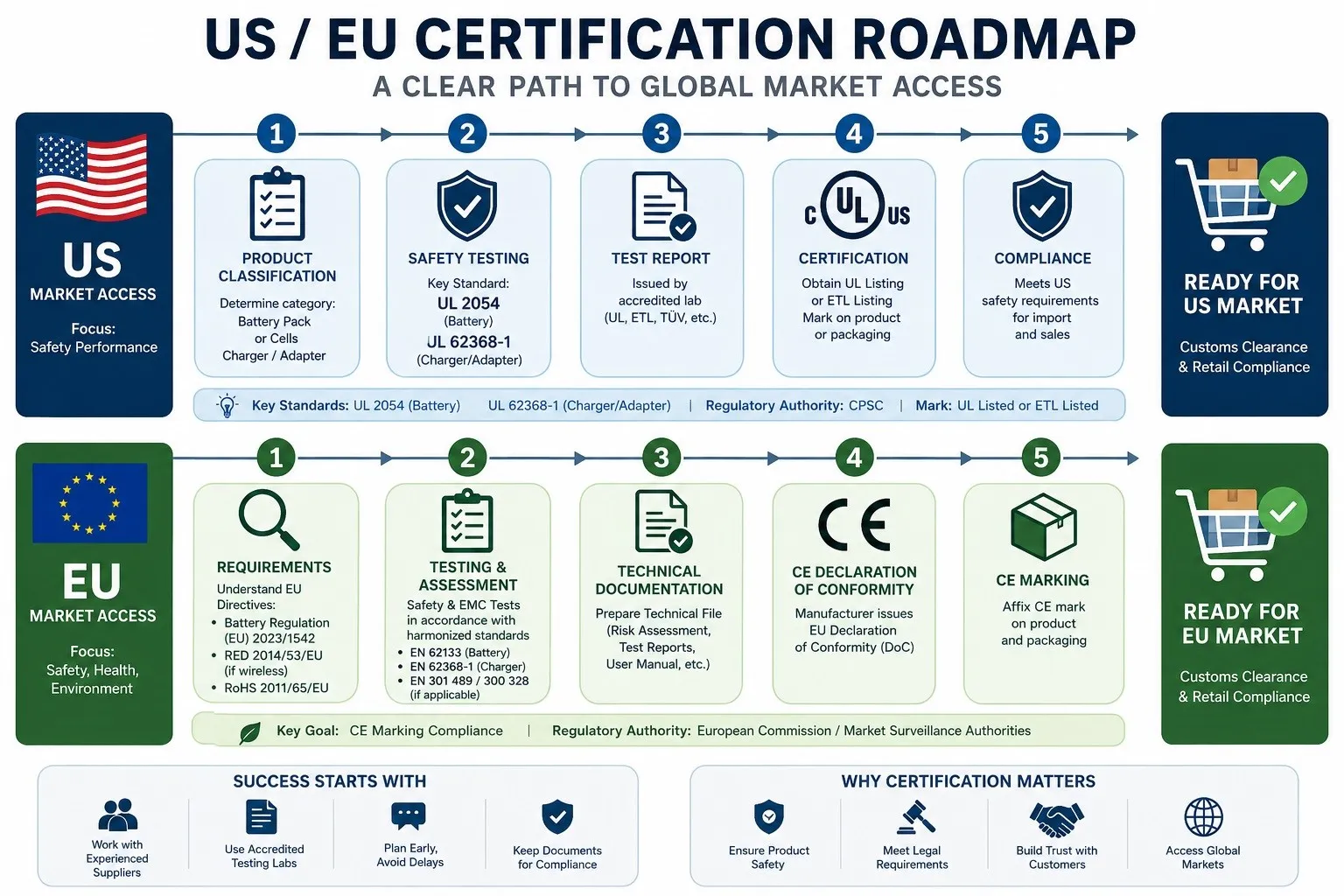
Why Battery Certification Matters
Related guide: How to Choose an E-Bike Battery Supplier in China.
Lithium batteries store a large amount of energy in a compact space. If the battery pack is poorly designed, incorrectly charged, physically damaged, or shipped without proper documents, safety risk increases. That is why transportation companies, customs authorities, platforms, retailers, and insurers often ask for battery-related documents.
Certification also protects buyers. It forces suppliers to define product structure, cell type, BMS design, charger matching, labels, and packaging more clearly. For procurement teams, documents create accountability.
However, buyers should remember one important point: certificates are only useful when they match the actual product being purchased.
UN38.3: Transportation Safety for Lithium Batteries
UN38.3 is one of the most commonly requested documents for lithium battery transport. It relates to battery safety during transportation and includes tests such as altitude simulation, thermal test, vibration, shock, external short circuit, impact or crush, overcharge, and forced discharge depending on battery type.
For e-bike battery buyers, UN38.3 is usually needed for air, sea, rail, or road shipping arrangements. Freight forwarders may request the UN38.3 test report and summary before accepting the goods.
When checking UN38.3 documents, verify:
- Battery model
- Voltage and capacity
- Manufacturer name
- Test laboratory
- Test standard version
- Date of report
- Whether the report matches the battery you are ordering
Do not accept a generic document that does not match the product.
MSDS: Material Safety Data Sheet
MSDS, or Safety Data Sheet, provides information about the battery materials, hazards, handling, storage, emergency measures, and transportation guidance. Logistics providers often request it together with UN38.3.
MSDS is not the same as a performance certificate. It does not prove that the battery is high quality. It mainly helps shipping and safety handling. Still, it is an important basic document for lithium battery export.
CE Marking for the European Market
For the European market, CE-related compliance may be required depending on the product and how it is sold. A battery pack, charger, electrical system, and complete e-bike may involve different directives and standards. Buyers should not treat CE as just a sticker.
For battery procurement, ask the supplier what CE documents are available and whether they apply to the battery pack, charger, or complete system. Also check whether the test report model matches your product.
If you sell a complete e-bike, the battery is only one part of the compliance picture. The complete vehicle may need its own compliance evaluation.
RoHS: Restricted Substances Compliance
RoHS relates to the restriction of certain hazardous substances in electrical and electronic equipment. For European buyers, RoHS documents may be requested by customers, platforms, or regulatory checks.
For procurement, RoHS is especially relevant when dealing with battery packs, chargers, cables, connectors, controllers, and electronic components. Ask whether the supplier can provide RoHS reports for the battery pack or relevant components.
IEC-Related Battery Safety Standards
IEC-related standards may be requested for lithium battery safety depending on the application and target market. They can cover aspects such as cell safety, industrial battery safety, testing methods, and system-level requirements.
For B2B buyers, the practical point is simple: do not just ask "Do you have IEC?" Ask which IEC standard, which model was tested, and whether the tested product is the same as your planned battery.
UL-Related Requirements in North America
In the US and Canada, UL-related standards are often important for e-bike batteries and complete electrical systems, especially when selling through formal retail channels, fleets, public programs, or markets with stricter safety expectations.
UL-related compliance can be more complex and more expensive than basic export documents. It may involve the battery pack, charger, drive system, or complete e-bike. Therefore, buyers should discuss UL-related needs before product development, not after production.
If your sales channel requires UL-related certification, tell the battery manufacturer early. The battery design, BMS, cells, enclosure, charger, label, and production control may need to follow the tested configuration.
Charger Certification Is Also Important
Many battery problems come from charger mismatch. If the battery and charger are sold together, charger compliance must be checked as well. A certified battery paired with a poor charger can still create safety and warranty risks.
Ask about:
- Charger input voltage range
- Output voltage and current
- Plug type
- Safety protection
- Certificates for the target market
- Compatibility with the battery BMS
For importers, charger documents are often requested separately from battery documents.
Labels, Manuals, and Packaging
Compliance is not only about test reports. Battery labels, warning marks, user manuals, and packaging labels also matter. Incorrect labeling can cause shipping delays or customer complaints.
A proper e-bike battery label may include voltage, capacity, energy Wh, model number, warning information, polarity, manufacturer information, and certification marks where applicable. Shipping cartons may require lithium battery marks or dangerous goods labels depending on transportation rules.
How to Verify Supplier Documents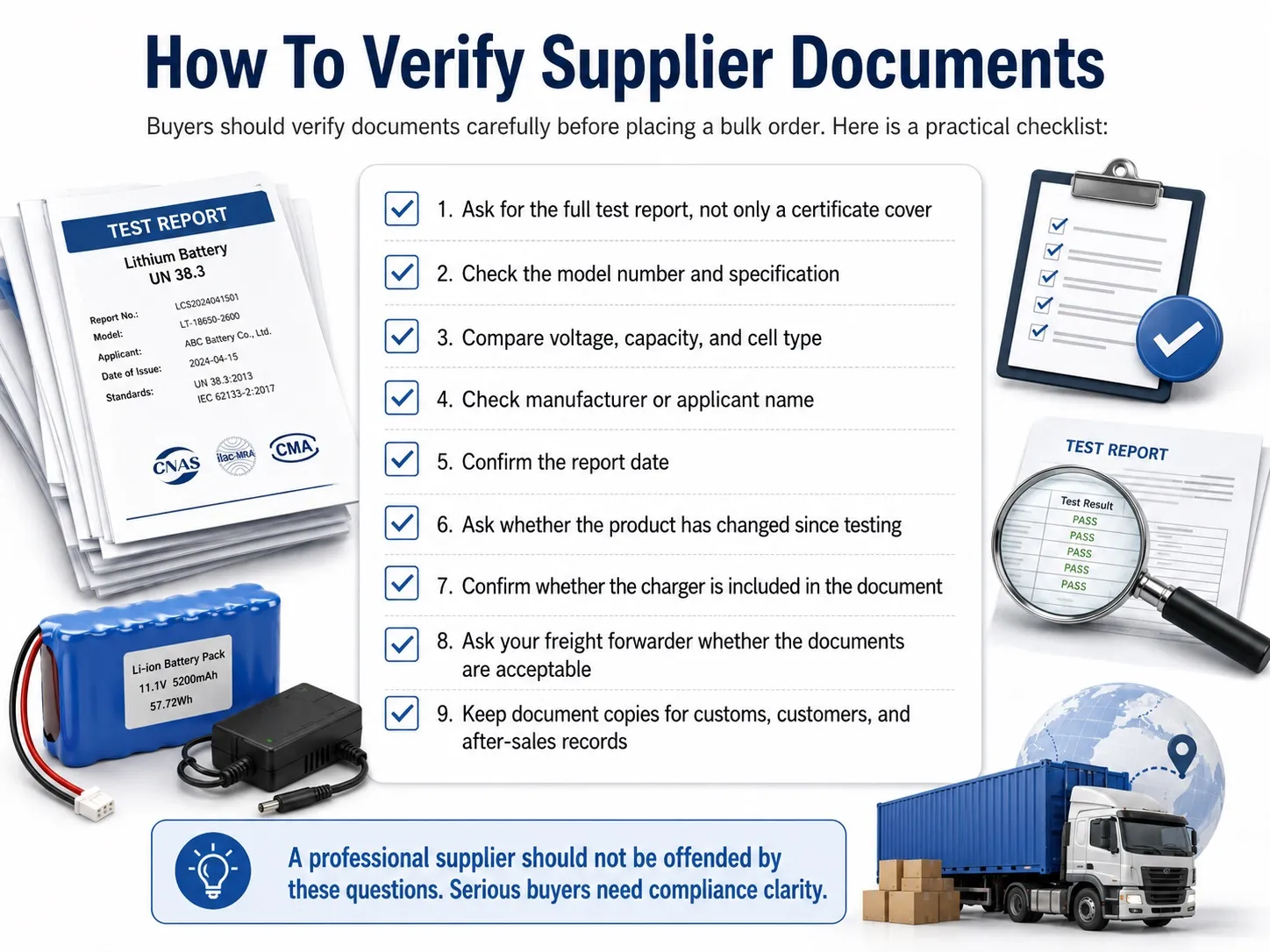
Buyers should verify documents carefully before placing a bulk order. Here is a practical checklist:
- Ask for the full test report, not only a certificate cover
- Check the model number and specification
- Compare voltage, capacity, and cell type
- Check manufacturer or applicant name
- Confirm the report date
- Ask whether the product has changed since testing
- Confirm whether the charger is included in the document
- Ask your freight forwarder whether the documents are acceptable
- Keep document copies for customs, customers, and after-sales records
A professional supplier should not be offended by these questions. Serious buyers need compliance clarity.
Common Certification Mistakes Buyers Make
Related guide: Common Mistakes When Importing E-Bike Batteries From China.
The most common mistake is assuming one certificate covers all models. In many cases, changing voltage, capacity, cell model, charger, housing, or BMS may affect the relevance of a test report.
Another mistake is leaving certification until the end. If your product must meet a specific market requirement, discuss it at the design stage. Retesting after design changes can delay launch and increase cost.
A third mistake is accepting certificates that belong to another unrelated factory or model. This may work in casual conversations but fail when real verification is required.
How GEB Supports Compliance-Focused Battery Procurement
GEB helps B2B buyers develop e-bike battery solutions with compliance awareness from the early stage. Depending on the project, GEB can support document preparation, battery labeling, transportation documents, charger matching, and technical communication for target market requirements.
For brands and distributors selling to Europe, North America, or other regulated markets, choosing a supplier with real testing discipline is more important than choosing a supplier that only sends certificate pictures.
If your e-bike batteries are intended for the US or EU market, certification planning should start before sample development. GEB can help review your project requirements and identify which certification documents may be needed based on your target market, battery specifications, and application. Contact GEB here: https://www.gebbattery.com/contact-us
FAQ
Is UN38.3 enough to sell an e-bike battery in Europe or the US?
No. UN38.3 is mainly related to transportation safety. Selling in a market may require additional compliance documents depending on the product, sales channel, charger, and complete e-bike system.
Can one certificate cover all battery models?
Not always. If voltage, capacity, cell model, BMS, housing, charger, or structure changes, the certificate may not fully apply. Always verify the tested model.
Should certification be discussed before or after sample approval?
Before sample development if certification is required. The sample should be designed close to the final certified version to avoid expensive redesign.
Can GEB help buyers prepare battery documents for export?
Yes. GEB can support B2B customers with battery-related documents, labeling, packaging, and technical files based on project requirements and target markets.


