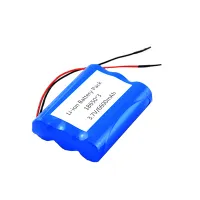
In today's global battery market, safety and compliance are not optional-they're the foundation of trust and international competitiveness. For battery suppliers, obtaining UL Certification is far more than a regulatory checkbox. It is a mark of reliability, proof of engineering quality, and a passport to global market access.

Understanding UL Certification
What Is UL Certification?
UL (Underwriters Laboratories) is an independent global safety organization established in 1894 that tests and certifies products for electrical, mechanical, and environmental safety. When a battery is UL certified, it means it has undergone rigorous evaluation to ensure protection against fire, electric shock, chemical leakage, and other potential hazards.
UL tests include:
- Electrical safety - overcharge, short-circuit, and over-discharge testing.
- Mechanical safety - crush, vibration, and drop resistance.
- Environmental reliability - performance under high/low temperature and humidity cycles.
For more about UL's role in global safety standards, you can visit the UL Solutions official site.
UL Certification vs. Other Standards
While several international certifications exist, UL remains the most recognized benchmark for safety in North America.
- CE focuses on regulatory compliance within the EU.
- RoHS restricts hazardous substances.
- UN38.3 governs battery transport safety.
- UL, however, certifies product-level safety performance and manufacturing integrity-a crucial distinction for market entry in the U.S. and Canada.
For comparison of these frameworks, the U.S. Consumer Product Safety Commission offers additional insights on battery safety compliance.
Why UL Certification Matters for Battery Suppliers
1. Market Access and Compliance
UL Certification is a de facto requirement for entry into the U.S. and Canadian markets, where retailers and importers often refuse non-certified batteries. Online marketplaces such as Amazon and Walmart mandate UL-compliant documentation for lithium batteries to prevent liability and safety incidents.
Common UL standards include:
- UL 2054 – Household and commercial battery packs.
- UL 2271 – Light electric vehicle (e-bike and e-scooter) batteries.
- UL 1974 – Repurposing of EV batteries into energy storage systems (ESS).
2. Safety and Liability Protection
UL testing ensures batteries can withstand extreme conditions such as short-circuiting, overcharging, crushing, and high-temperature exposure.
For suppliers, this reduces:
- Product recall risks.
- Legal and insurance liabilities.
- Reputational damage in case of failures.
Insurance providers often reward UL-certified manufacturers with lower premiums, recognizing their reduced product liability risks.
3. Brand Credibility and Long-Term Partnerships
A UL Mark signals third-party validation and commitment to consistent quality. OEMs, EV brands, and industrial clients prefer UL-certified suppliers because it reduces their own risk exposure. In competitive global markets, UL Certification differentiates brands that value safety, transparency, and continuous quality improvement.

UL Standards for Different Battery Applications
|
Application |
UL Standard |
Description |
|
Cell-level safety |
UL 1642 |
Lithium-ion cells-tests for overcharge, short-circuit, and thermal stability |
|
Consumer packs |
UL 2054 |
Portable and household battery packs |
|
E-bike and LEV |
UL 2271 |
Light electric vehicle battery systems (e-bike, scooter) |
|
EV systems |
UL 2580 |
Electric vehicle traction batteries |
|
Energy storage reuse |
UL 1974 |
Second-life battery repurposing for ESS |
UL 2271 has become particularly important for e-bike and micro-mobility systems, ensuring safer adoption of lithium-ion technology in urban transport.
UL Listed vs. UL Recognized – What's the Difference?
|
Aspect |
UL Listed |
UL Recognized |
|
Scope |
Complete finished product |
Components (e.g., cells, modules) |
|
Testing Level |
Evaluated as final system |
Evaluated for integration into systems |
|
Usage |
Can be sold as standalone product |
Must be used within UL Listed equipment |
|
Example |
Entire e-bike battery pack |
Individual lithium cell |
In simple terms, a UL Listed battery has passed all necessary product-level tests, while UL Recognized components are partially evaluated and require further system-level validation.
This distinction matters-choosing UL Listed products ensures compliance across your entire application.
You can find more on UL listings in the official UL Product iQ database.
How to Obtain and Maintain UL Certification
Step-by-Step Certification Process
- Identify applicable UL standards (e.g., UL 2271 for e-bikes).
- Submit samples to UL-authorized labs for testing.
- Undergo factory inspection and process review.
- Receive certification and UL Mark upon approval.
Ongoing Factory Inspections
UL field representatives inspect certified factories at least four times per year to ensure continuous compliance. Manufacturers must maintain consistent quality and document any production or material changes.
Technical Design Considerations
To pass UL tests, manufacturers often:
- Integrate multi-level BMS protection (over-voltage, over-current, temperature).
- Use robust mechanical housings to prevent crush or puncture failure.
- Optimize thermal management for stable cell temperature.
How to Verify a Supplier's UL Certification
Check the UL Certificate Online
- Visit the UL Product iQ directory.
- Search by company name, file number, or product model.
- Verify matching manufacturer details and scope.
- Watch for red flags such as missing product categories or incomplete certificates.
Procurement Tip
Always request a UL file number or test summary from your supplier. This ensures the certification applies to the specific battery model you plan to purchase.
How UL Certification Shapes Battery Design and Quality
UL standards influence product design from the ground up.
Certified batteries typically incorporate:
- Smart BMS architecture for real-time safety monitoring.
- Reinforced mechanical casing to prevent deformation.
- Controlled thermal propagation mechanisms to contain cell failure.
By driving these design improvements, UL Certification not only ensures compliance but also promotes innovation, sustainability, and long-term performance reliability.
Conclusion
UL Certification is more than a safety badge-it's a business advantage. It ensures batteries are safe, compliant, and trusted across international markets. For battery suppliers, achieving UL Certification builds long-term brand equity, fosters global partnerships, and minimizes operational risk.
About GEB:
GEB, a brand under General Electronics Technology Co., LTD, specializes in electric bicycle lithium batteries. Since establishing its factory in 2009, GEB has built a strong reputation across Europe and North America for high-quality, high-performance, and eco-friendly battery solutions. Our mission is to provide premium, sustainable power for e-bike users in Western markets-promoting the growth of green urban mobility.
GEB holds multiple international certifications, including UL, CE, and RoHS, ensuring full compliance with global market standards. For OEM/ODM clients, We offers a complete development process-from concept design and sample testing to production and quality tracking-with dedicated support at every step.
Contact us now to learn more about e-bike batteries or get a free quote.