


Depth of Discharge (DOD) refers to the percentage of a battery's nominal capacity that is actually discharged during a charge-discharge cycle. It's a crucial parameter for measuring battery usage and directly impacts its lifespan and performance.
In the world of solar energy storage, electric vehicles (EVs), and consumer electronics, the concept of Depth of Discharge (DoD) plays a critical role in determining how long a battery lasts and how well it performs. Therefore, this guide will provide a detailed explanation of what depth of discharge (DOD) is to help you make better purchasing decisions.

What is Depth of Discharge (DoD)?
Depth of Discharge (DoD) refers to the percentage of a battery's total capacity that has been used during a discharge cycle. In other words, it measures how much of the stored energy has been consumed.
Example: If a 100Ah battery delivers 40Ah of energy, the DoD is 40%.
DoD is closely linked to another key metric: State of Charge (SoC). While DoD tells you how much energy has been used, SoC shows how much remains. The relationship is simple:
Formula:
SoC = 100% − DoD
Example: If a battery's SoC is 30%, its DoD is 70%.
This DoD vs SoC relationship is critical in battery monitoring and management, especially in systems where precise energy tracking is required.
How to Calculate Depth of Discharge
The formula for calculating DoD is straightforward:
DoD (%) = (Discharged Capacity ÷ Total Capacity) × 100
Example: A 100Ah battery that has discharged 30Ah has a DoD of 30%.
This calculation works the same for batteries of any size. For instance:
- A 200Ah battery that delivers 100Ah → DoD = 50%.
- A 50Ah battery that delivers 25Ah → DoD = 50%.
Accurate DoD calculations are important for system design, energy forecasting, and performance analysis in applications like renewable energy and electric mobility.
How Depth of Discharge Affects Battery Life
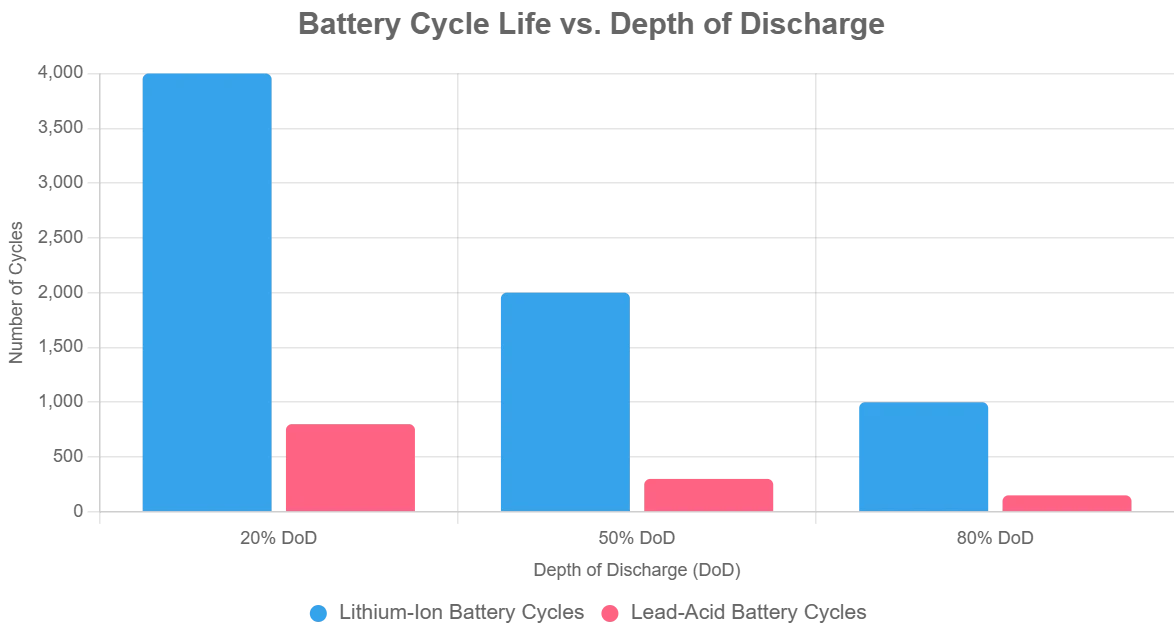
One of the most important reasons to monitor DoD is its direct link to battery cycle life. The deeper a battery is discharged during each cycle, the fewer total cycles it will provide. Conversely, shallow discharges significantly extend its lifespan.
- At 10% DoD: a lithium-ion battery may achieve up to 5,000 cycles.
- At 80% DoD: the same battery might only last around 500 cycles.
This exponential difference shows why controlling DoD is the single biggest factor in reducing battery degradation and maximizing lifetime performance.
Visualizing this relationship in a cycle life vs DoD graph helps highlight how a modest reduction in DoD can dramatically extend overall usable life.
To illustrate, here's a chart comparing the cycle life of lithium-ion and lead-acid batteries at different DoD levels:
DoD in Different Battery Chemistries
Lithium-Ion Batteries
- Recommended DoD range: 20%–80% for optimal cycle life.
- Some types, such as LiFePO₄ (Lithium Iron Phosphate), can tolerate 90%–100% DoD without severe degradation.
- Applications: EVs, solar energy storage systems, and portable electronics.
Lead-Acid Batteries
- Recommended DoD range: ≤50% to avoid rapid sulfation and capacity loss.
- Deep discharges beyond 50% sharply reduce cycle life.
- Applications: UPS backup power, off-grid solar systems, RVs.
Nickel-Based Batteries (NiMH / NiCd)
- Recommended DoD range: 30%–70%.
- Commonly used in older hybrid vehicles and legacy electronics.
- Less popular today, as lithium-ion batteries dominate due to higher efficiency and durability.
Depth of Discharge in Different Applications
The importance of Depth of Discharge varies depending on how a battery is used. Each application has different demands for energy availability and cycle life, which means DoD must be optimized accordingly.
- Solar Energy Storage Systems: High DoD batteries, especially lithium-ion solar batteries, maximize usable capacity and improve system efficiency. For off-grid homes or solar-plus-storage setups, lithium batteries with 80%–90% DoD provide both energy independence and long service life.
- Electric Vehicles (EVs): EV manufacturers typically limit daily DoD to around 20%–80%. This balance ensures that drivers enjoy sufficient range while protecting the battery from premature degradation. Tesla and other EV brands use smart battery management systems to enforce these DoD windows.
- E-Bike Batteries: In e-bikes, carefully managing DoD helps prevent deep discharges that shorten battery life. Keeping daily DoD moderate (often within 60%–80%) ensures a longer cycle life and better reliability for commuters and enthusiasts.
- Consumer Electronics (Smartphones, Laptops): Devices like smartphones rarely allow the battery to reach full 100% discharge. Instead, their charging systems are designed to cap usage at ≤80% DoD during regular operation, which helps slow down capacity fade and extends usable life.
How to Manage and Optimize Depth of Discharge
Effective DoD management is key to maximizing both performance and lifespan. Here are practical strategies used across industries:
1. Battery Management System (BMS)
A BMS continuously monitors voltage, current, and temperature to prevent over-discharge or overcharge. This is especially important in lithium-ion systems, where exceeding safe DoD ranges can compromise safety and durability.
2. Charging Strategy Optimization
- Partial Charging: EVs often use a "charge to 80%" strategy for daily use, avoiding unnecessary high DoD cycles.
- Balancing Charge: In multi-cell battery packs, balancing ensures no single cell experiences excessive DoD, improving overall system stability.
3. Temperature Control
Heat accelerates chemical degradation in deep discharge conditions. Using cooling systems or avoiding high-temperature operation helps maintain cycle life.
4. Choosing the Right Battery Chemistry
- For high DoD applications (solar or EVs), lithium-ion batteries (especially LiFePO₄) are the best choice.
- For budget-conscious systems, lead-acid batteries can still be viable if managed with low DoD to preserve lifespan.
FAQ
Q1: What is the best DOD for lithium batteries?
A: The ideal range is typically 20%–80%, balancing usable capacity and long cycle life. Some lithium chemistries, such as LiFePO₄, can handle up to 90% DoD in daily use.
Q2: Can I discharge my battery to 100% DoD?
A: While technically possible, fully discharging to 100% DoD will dramatically shorten lifespan, especially for lead-acid batteries. Lithium-ion batteries can tolerate occasional full discharges but perform best with partial DoD.
Q3: How do I calculate DoD?
A: Use the formula:
DoD = (Discharged Capacity ÷ Total Capacity) × 100%
Example: If a 100Ah battery discharges 30Ah, the DoD is 30%.
Q4: What's the difference between DoD and SoC?
A: DoD measures the portion of energy used, while SoC (State of Charge) measures the portion remaining. They are complementary:
SoC = 100% − DoD.
Q5: How does DoD affect solar batteries?
A: In solar storage systems, DoD defines how much stored energy can be used daily without harming the battery. High DoD lithium batteries are preferred for off-grid and peak-shaving applications.
Conclusion
Discharge Depth of Power (DOD) is a "health indicator" in battery usage, directly affecting battery lifespan and cost. Reasonable control of DOD (such as avoiding long-term deep discharge) can significantly extend battery lifespan and reduce the total life cycle cost. In simple terms, DOD is a measurement of how much a battery is used. Reasonable control of it can prolong battery lifespan, just like a mobile phone avoiding running out of power before recharging. In practical applications, it is necessary to combine the battery type, usage scenario and management system to formulate the optimal charging and discharging strategy.
For more information on lithium batteries or to obtain a quote on e-bike batteries, please contact our professional team.


