


For e-bike brands and battery distributors, a reliable battery supply chain is a competitive advantage. The battery is not a simple spare part. It affects product range, user safety, warranty cost, inventory planning, shipping complexity, and customer satisfaction. If battery supply is unstable, the entire e-bike business becomes unstable.
A strong supply chain is not built by finding one cheap supplier. It is built through clear specifications, qualified partners, stable materials, quality control, documentation, forecasting, and after-sales cooperation.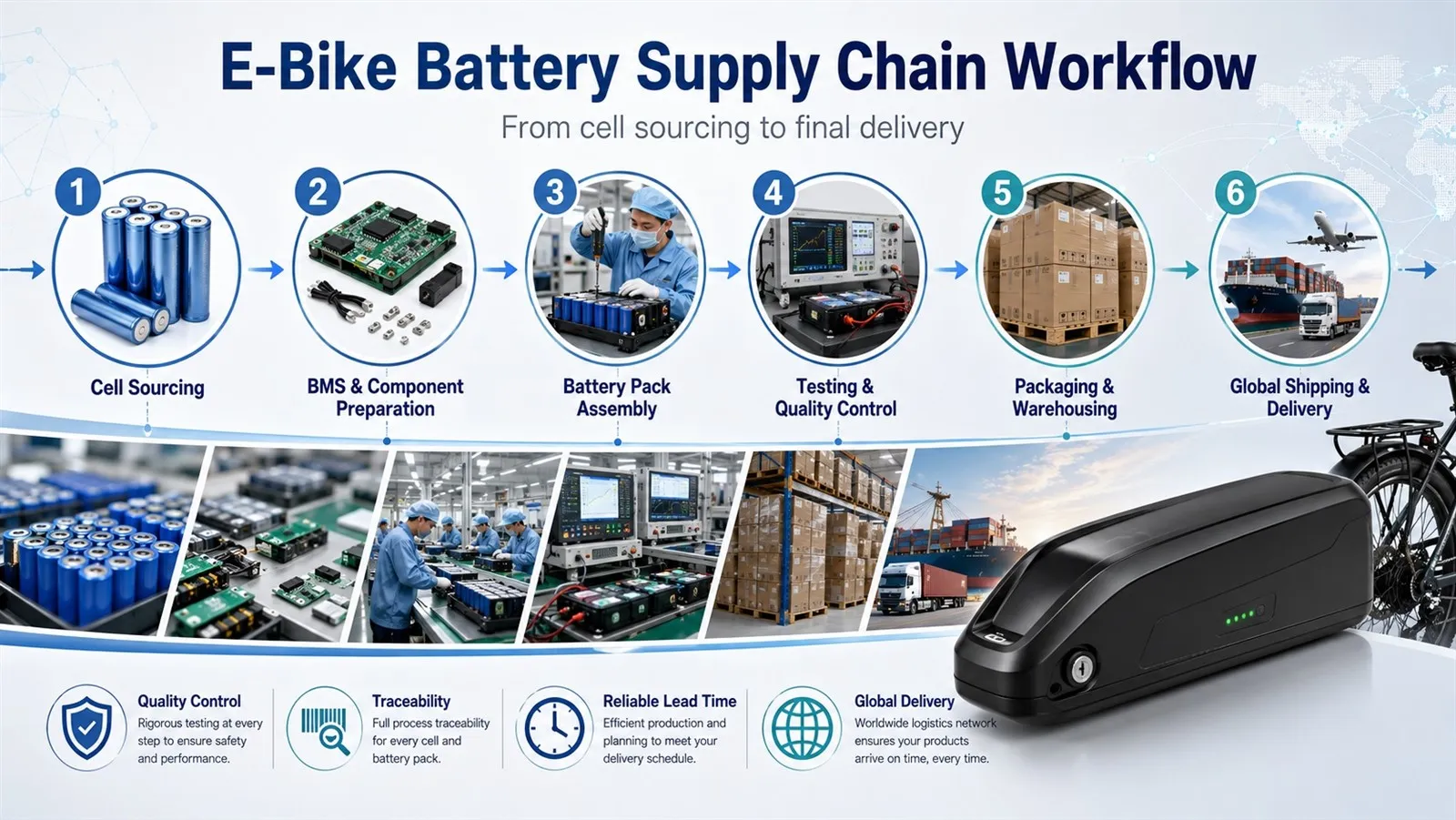
This guide explains how to build a reliable e-bike battery supply chain for long-term business growth.
Define Your Battery Platform Strategy
Before choosing suppliers, decide your battery platform strategy. Are you selling standard replacement batteries, private label batteries, or custom batteries for your own e-bike frames?
Standard replacement batteries are easier to source and usually have lower development risk. Custom integrated batteries can create stronger brand differentiation but require deeper engineering and longer development.
Your platform strategy should define:
- Main voltage range
- Capacity range
- Case types
- Connector standards
- Charger standards
- BMS requirements
- Target markets
- Certification level
- Warranty policy
- Spare parts plan
Without a platform strategy, every order becomes a new project. That increases complexity and makes quality harder to control.
Qualify Suppliers Before You Need Urgent Orders
Many buyers look for suppliers only when inventory is running out. That creates pressure and leads to bad decisions. Supplier qualification should happen before urgent demand appears.
A basic supplier qualification process should check:
- Manufacturing capability
- Battery engineering knowledge
- Cell sourcing process
- BMS selection ability
- Quality control process
- Certification support
- Export experience
- Communication speed
- Sample development ability
- Warranty response
Do not rely only on sales claims. Ask technical questions, request sample test data, and review documents.
Standardize Specifications
Specification standardization is one of the best ways to improve supply chain reliability. If every batch uses different connectors, labels, chargers, and BMS settings, mistakes become more likely.
Create standard documents for:
- Battery model naming
- Voltage and capacity
- Cell model
- BMS current
- Connector type
- Cable length
- Charger output
- Label layout
- Packaging requirement
- Test standard
- Warranty process
Standard documents reduce misunderstandings between purchasing, engineering, sales, and suppliers.
Build a Forecasting System
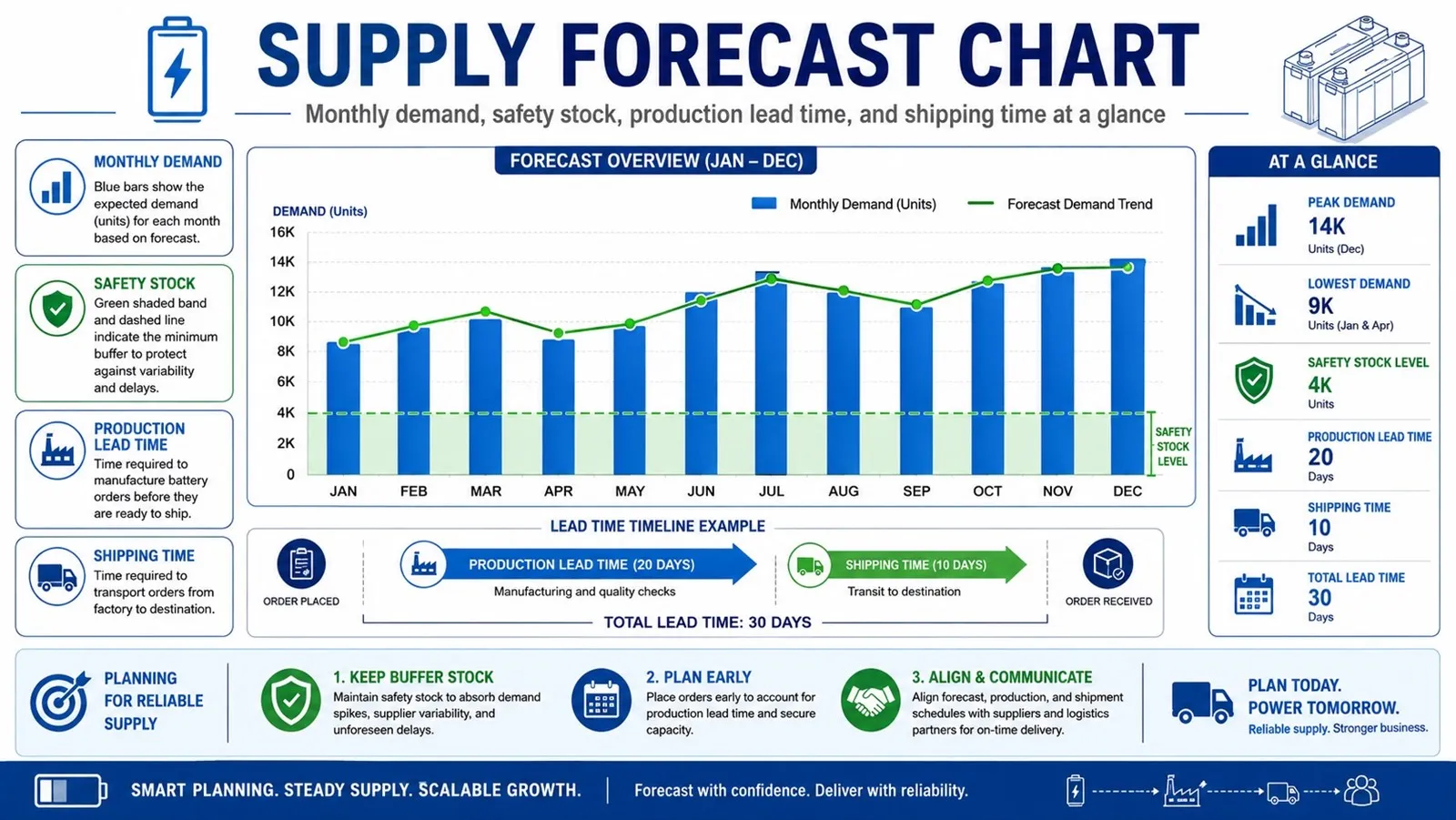
Battery production and shipping take time. If you order only when inventory is almost empty, you may face stockouts, expensive air freight, or rushed production.
A simple forecasting system should include:
- Monthly sales forecast
- Current inventory
- Safety stock level
- Production lead time
- Shipping lead time
- Seasonal demand
- Warranty replacement stock
- New product launch schedule
For distributors, safety stock is especially important. Battery shipping cannot always be accelerated easily because lithium battery logistics has restrictions.
Control Cell and BMS Consistency
Cell and BMS changes can affect performance, certification relevance, warranty behavior, and customer experience. If a supplier changes cell model without approval, the battery may behave differently even if the label remains the same.
Buyers should require approval for major component changes, including:
- Cell brand or model
- BMS supplier or current rating
- Charger model
- Connector type
- Case material
- Internal structure
- Label content
This does not mean suppliers can never improve materials. It means changes should be controlled and documented.
Use Batch Traceability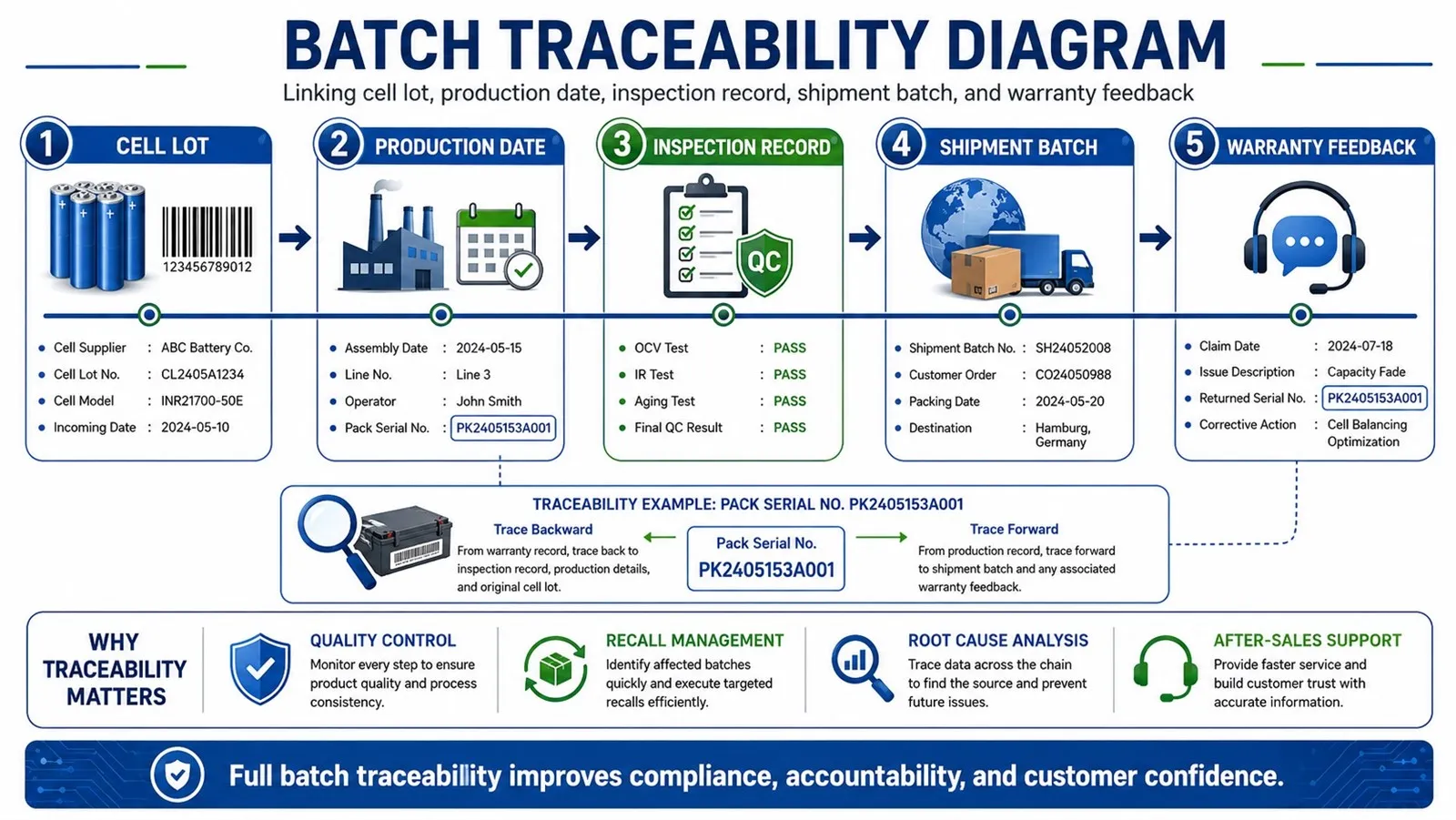
Traceability helps solve after-sales issues. If a customer reports a battery problem, you should be able to identify the production batch, shipment date, cell lot, and test records.
Ask the supplier whether they can provide batch numbers, serial numbers, production records, or shipment traceability. For larger B2B programs, serial number management can be very valuable.
Without traceability, one failure can create uncertainty around the whole shipment.
Plan Documentation Early
Related guide: E-Bike Battery Certifications for US and EU Markets.
Battery supply chains involve more documents than many buyers expect. Documents may include quotation, specification sheet, drawing, invoice, packing list, UN38.3, MSDS, CE, RoHS, charger documents, test report, label file, and user manual.
Create a document folder for each battery model. Keep updated versions and avoid mixing old and new files. If your product is sold through distributors or retailers, they may request documents months after the shipment.
Good document management makes your business look more professional.
Manage Warranty as a System
Warranty should not be handled case by case without structure. Define a process for collecting evidence, analyzing failure reasons, and deciding responsibility.
A practical warranty process includes:
- Customer report
- Photos or videos
- Serial number or batch number
- Charging history if available
- Usage environment
- Initial diagnosis
- Supplier technical review
- Replacement, repair, credit, or rejection decision
- Data summary for future improvement
Warranty data should feed back into product improvement. If the same issue repeats, the battery design or usage instructions may need adjustment.
Avoid Single-Point Dependency Without Losing Focus
Some buyers want many suppliers to reduce risk. Others want one supplier for simplicity. Both strategies have pros and cons.
A main supplier can provide consistency, better communication, and deeper cooperation. A backup supplier can reduce risk if supply is interrupted. However, using too many suppliers for the same product can create inconsistent quality and document confusion.
A balanced approach is to develop a strong primary supplier and one qualified backup for critical models.
Align Product Development With Supply Chain Reality
Related guide: E-Bike Battery Lead Time.
Sales teams may want many models and capacities. Supply chain teams may prefer fewer standard products. The best strategy balances market demand with operational control.
Too many battery models can increase inventory pressure, certification cost, packaging complexity, and after-sales confusion. Before launching a new battery model, ask:
- Does it serve a real market need?
- Can it share components with existing models?
- Is the MOQ realistic?
- Can it be certified and shipped efficiently?
- Can after-sales teams support it?
How GEB Supports Reliable E-Bike Battery Supply Chains
GEB works with e-bike brands, distributors, and B2B buyers on custom and standard e-bike battery solutions. Support can include specification review, OEM/ODM development, sample testing, mass production, quality control, labeling, packaging, and export documentation.
For long-term cooperation, GEB can help buyers standardize battery models, plan repeat orders, and improve supply chain stability.
For brands with repeated e-bike battery orders, a stable supply chain depends on more than unit price. Platform standardization, forecast planning, batch traceability, and long-term cooperation all help improve production consistency and delivery reliability. GEB can help review your order plans and build a more stable battery supply strategy for future projects. Contact GEB here: https://www.gebbattery.com/contact-us
FAQ
What makes an e-bike battery supply chain reliable?
Clear specifications, qualified suppliers, consistent components, quality control, certification support, realistic lead time, traceability, and structured warranty handling.
Should distributors keep safety stock?
Yes. Lithium battery production and shipping take time, so safety stock helps avoid urgent orders and expensive shipping.
Is one supplier enough for a battery business?
A strong primary supplier is valuable, but a qualified backup supplier can reduce risk for key models. The key is to maintain consistency and documentation control.
Can GEB support long-term supply chain cooperation?
Yes. GEB supports B2B customers with e-bike battery development, repeat orders, customization, documentation, and supply planning.


