


Lead time is one of the most important factors in e-bike battery procurement. A delayed battery shipment can delay a complete e-bike order, interrupt distributor inventory, or miss a seasonal sales window. For B2B buyers, understanding the battery production timeline helps prevent unrealistic schedules and last-minute pressure.
E-bike battery lead time depends on the project type, material availability, customization level, testing requirements, certification needs, order quantity, and shipping method. This article explains what happens from sample development to bulk delivery and how buyers can plan more effectively.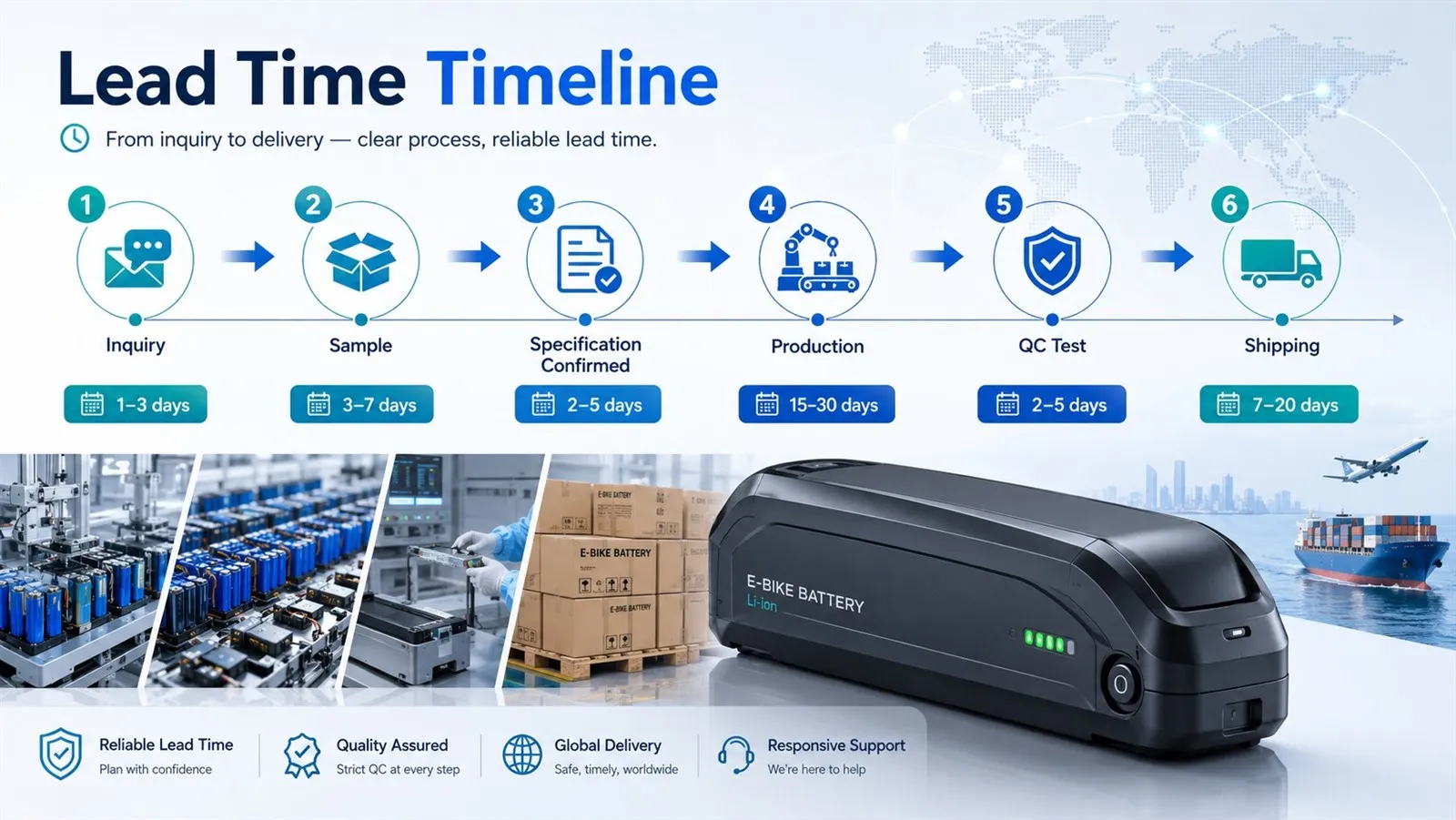
What Does Lead Time Mean?
Lead time is the time required to complete a process from order confirmation to delivery readiness or final arrival, depending on how the supplier defines it.
In battery procurement, there are several types of lead time:
- Quotation lead time
- Engineering confirmation time
- Sample lead time
- Sample testing time
- Mass production lead time
- Inspection and packing time
- Shipping lead time
- Customs clearance time
When a supplier says "delivery in 25 days," ask whether that means production completion, shipment from factory, arrival at port, or arrival at your warehouse.
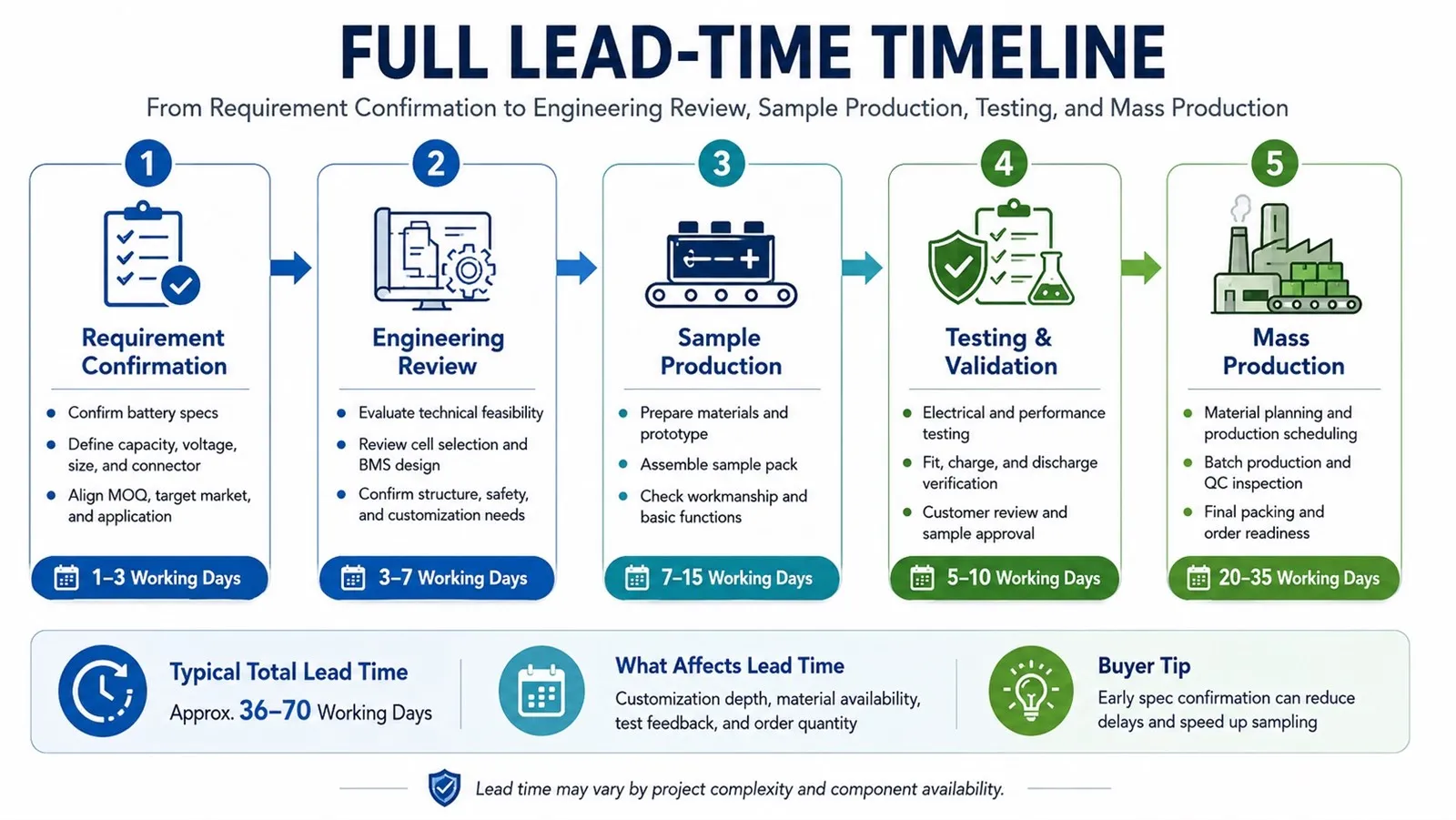
Stage 1: Requirement Confirmation
Before production begins, the supplier must confirm technical requirements. This stage can be fast for standard products but longer for custom battery packs.
Buyers should provide:
- Voltage and capacity
- Battery dimensions
- Case or installation type
- Motor power and controller current
- Connector type
- Cable length
- Charger requirement
- Label and packaging requirement
- Certification requirement
- Target order quantity
- Target market
The clearer your information, the shorter this stage becomes. Many delays happen because buyers provide incomplete specifications and then change details after quotation.
Stage 2: Engineering Review
For custom or semi-custom batteries, the manufacturer reviews whether the design is practical and safe. Engineers check cell arrangement, BMS selection, discharge current, housing space, insulation, thermal conditions, charging method, and assembly feasibility.
This stage is important because a battery that fits physically may still be electrically unsuitable. For example, a small case may not have enough space for the requested capacity and discharge current. A professional supplier should point this out early instead of forcing an unrealistic design.
Stage 3: Material Preparation
After order confirmation, the supplier prepares cells, BMS, case, connectors, wires, nickel strips, chargers, labels, and packaging materials. Material availability is a major factor in lead time.
Standard parts are usually faster. Special cells, custom BMS, unique connectors, private labels, or custom packaging can add time.
Buyers should ask whether key materials are in stock. If not, ask for the estimated purchasing time. During busy seasons, cell supply and shipping capacity can also affect schedules.
Stage 4: Sample Production
Sample production is not just assembling one battery. The supplier must follow the planned structure, test the BMS, check the wiring, confirm the case fit, apply labels, and perform basic charge and discharge tests.
For standard batteries, sample lead time may be relatively short. For custom projects, it may take longer because engineers may need to adjust layout, connectors, firmware, or mechanical details.
After receiving samples, the buyer should test:
- Physical fit
- Mounting stability
- Charging behavior
- Range performance
- Discharge under load
- Connector compatibility
- Display or controller communication if applicable
- Heat behavior during use
- User experience and appearance
The buyer's testing time should be included in the project schedule.
Stage 5: Sample Feedback and Modification
It is common for custom samples to require small adjustments. The connector may need to be longer. The label may need different content. The BMS current may need adjustment. The case may need mounting changes.
Do not treat modifications as failure. This is exactly why samples exist. However, too many changes can delay mass production. To keep the timeline under control, collect all feedback in one document and prioritize critical issues.
Stage 6: Mass Production
Once the sample is approved, the supplier can move into mass production. The production process usually includes cell sorting, pack assembly, spot welding, BMS connection, insulation, case assembly, charge and discharge testing, aging, appearance inspection, labeling, and packing.
For lithium battery packs, rushing production is risky. Aging tests and inspections take time. If a supplier promises unrealistic lead time for a large customized order, ask how they will still complete testing properly.
Stage 7: Inspection and Documentation
Before shipment, buyers should confirm inspection and documents. Depending on the order, documents may include invoice, packing list, battery test summary, UN38.3, MSDS, certification files, shipping labels, and product photos.
For larger orders, buyers may request pre-shipment inspection. This can include quantity check, appearance check, label check, carton check, voltage sampling, and random function testing.
Inspection should happen before the goods leave the factory. It is much easier to solve problems before shipment than after arrival.
Stage 8: Shipping and Delivery
Lithium battery shipping requires planning. Air, sea, rail, truck, or express routes may have different document requirements and delivery times. For some destinations, door-to-door battery shipping may be available, but cost and timing must be confirmed.
Buyers should ask:
- What shipping method is recommended?
- Is the battery shipped as dangerous goods?
- Are UN38.3 and MSDS accepted by the forwarder?
- Are cartons labeled correctly?
- What is the estimated transit time?
- Is customs clearance included?
- What happens if shipment is delayed?
Shipping lead time can be longer than production lead time, especially for sea freight or remote destinations.
How Buyers Can Reduce Lead Time Risk
Related guide: E-Bike Battery MOQ Explained.
The best way to reduce lead time risk is planning early. Here are practical steps:
- Finalize specifications before quotation
- Use existing battery platforms when possible
- Approve samples quickly but carefully
- Avoid changing labels or connectors after production starts
- Provide realistic forecasts
- Confirm certification needs early
- Reserve time for logistics and customs
- Keep safety stock for repeat orders
For seasonal products, place orders before peak demand. Waiting until inventory reaches zero can cause emergency procurement, higher shipping cost, and rushed decisions.
Why Stable Communication Matters
Related guide: How to Build a Reliable E-Bike Battery Supply Chain.
Lead time is not only about factory capacity. Communication speed also matters. If the buyer takes a week to confirm a connector drawing, the whole schedule moves. If the supplier does not update material status, the buyer cannot plan sales.
A professional supplier should provide clear timelines, production updates, and early warnings if any issue appears.
How GEB Supports Lead Time Planning
GEB supports e-bike battery buyers from specification review to sample development, bulk production, testing, packaging, and export preparation. For standard and custom projects, GEB can help buyers evaluate realistic lead time based on materials, quantity, customization, and target delivery schedule.
For brands and distributors, the best lead time is not the shortest promise. It is the shortest reliable timeline that still protects quality and safety.
A successful e-bike battery launch or repeat order depends on a realistic timeline for sample development, testing, production, inspection, and shipping. GEB can help review your project schedule and build a practical timeline based on your specifications, order quantity, and target delivery date. Contact GEB here: https://www.gebbattery.com/contact-us
FAQ
Why does custom battery production take longer than standard models?
Custom projects may require engineering review, special materials, sample adjustment, custom BMS, labels, packaging, and additional testing. Standard models use existing platforms and are usually faster.
Can sample testing time affect the final delivery schedule?
Yes. If the buyer takes longer to test samples or requests multiple modifications, mass production will start later. Sample approval is a key timeline milestone.
Is faster lead time always better?
No. Batteries require proper assembly, aging, and testing. Unrealistically fast delivery may mean quality checks are reduced.
Can GEB help plan repeat orders?
Yes. GEB can work with B2B customers on order forecasts, sample schedules, production planning, and bulk delivery arrangements.


