


China is one of the most important manufacturing bases for e-bike batteries. Buyers can find standard replacement batteries, custom battery packs, OEM/ODM solutions, and competitive pricing. However, importing e-bike batteries also involves technical, compliance, logistics, and after-sales risks.
Many problems are not caused by bad intentions. They happen because specifications are unclear, samples are not tested properly, documents are incomplete, or buyers compare only price. This article explains common mistakes when importing e-bike batteries from China and how to avoid them.
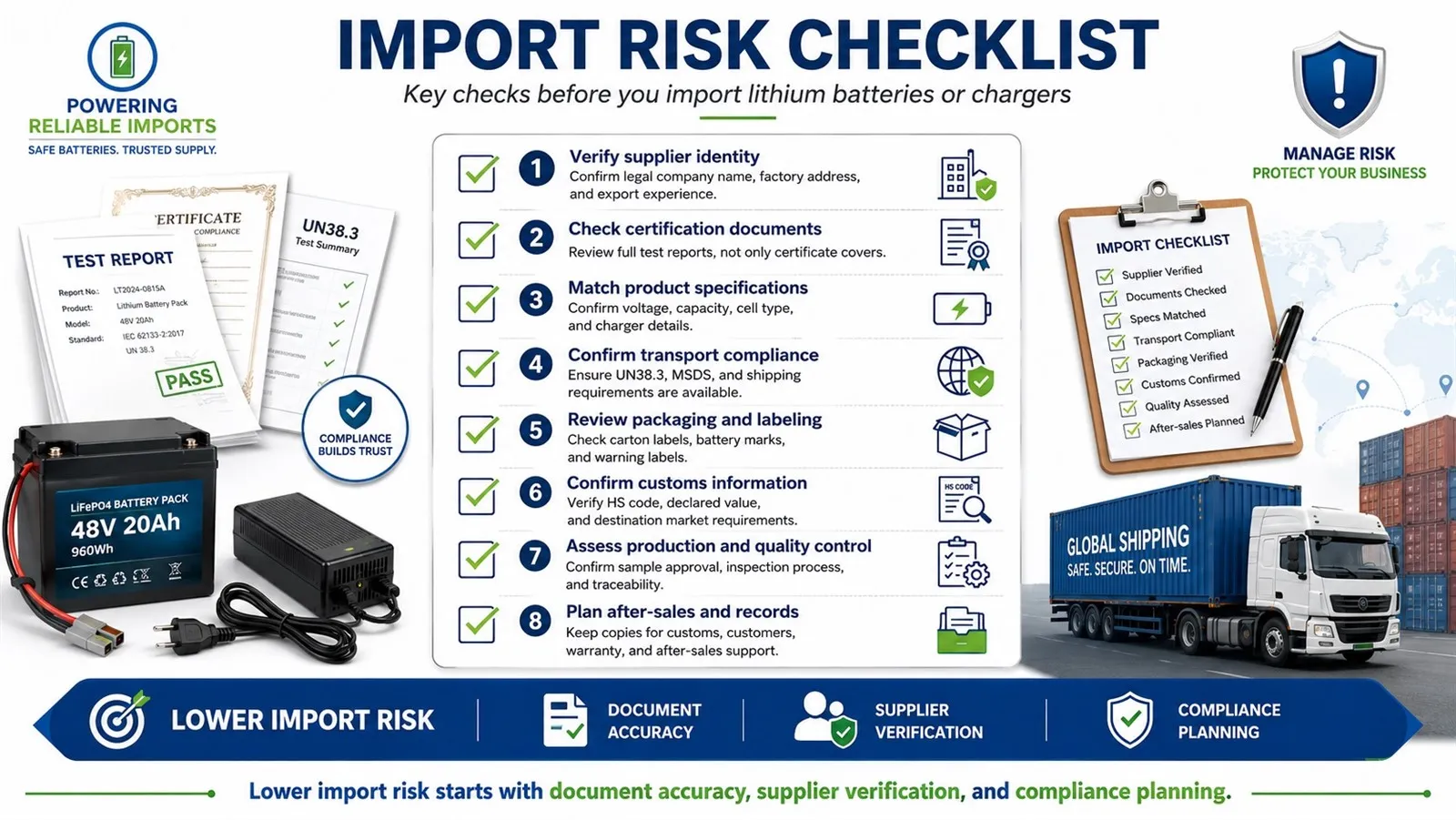
Mistake 1: Asking for Price Before Defining Specifications
Many buyers start with a message like: "Please quote 48V 20Ah battery." That is not enough information. A 48V 20Ah battery can be built in many ways.
The supplier needs to know the motor power, controller current, case type, dimensions, connector, charger requirement, discharge current, target market, certification needs, and order quantity. Without these details, the quotation may be inaccurate.
How to avoid it: prepare a technical requirement sheet before contacting suppliers. If you are replacing an existing battery, send photos of the battery, label, connector, mounting rail, charger, and e-bike model.
Mistake 2: Comparing Only Unit Price
Related guide: How to Compare E-Bike Battery Quotations.
The lowest price may look attractive, especially for distributors trying to protect margins. But e-bike battery cost is connected to cells, BMS, housing, testing, certification, packaging, warranty, and logistics.
A low-cost battery may use lower-grade cells, a weak BMS, thin nickel strips, poor insulation, or limited testing. These savings can turn into customer complaints, returns, and brand damage.
How to avoid it: compare quotations by total value. Ask for cell model, BMS current, protection functions, test process, warranty terms, certification documents, and packaging details.
Mistake 3: Ignoring BMS Current and Motor Load
Some buyers choose batteries based only on voltage and Ah. They forget to check whether the BMS can support the actual motor load. If the BMS current is too low, the battery may cut off during acceleration, climbing, or heavy cargo use.
How to avoid it: provide the motor rated power, controller current, and expected riding conditions. Ask the supplier to recommend continuous and peak discharge current based on the application.
Mistake 4: Not Testing Samples Under Real Conditions
A battery that works on a desk may not perform well on the road. Real riding creates vibration, peak current, temperature changes, mounting stress, and repeated charging cycles.
Some buyers approve samples after only checking appearance and voltage. Later, mass production batteries may show fit, range, or cut-off problems.
How to avoid it: test samples on the actual e-bike. Check installation, charging, acceleration, hill climbing, range, heat, display compatibility, and user handling. Record issues clearly before approving mass production.
Mistake 5: Accepting Weak or Unmatched Certificates
Related guide: What Certifications Do E-Bike Batteries Need for the US and EU Markets?.
Certificates are sometimes shared casually in international trade. A supplier may send a report that belongs to a different model, different voltage, different capacity, or even a different factory. This can cause problems during shipping, customs, platform review, or customer audits.
How to avoid it: check the model number, voltage, capacity, manufacturer name, test laboratory, and test date. Confirm that the document matches the product you are buying. Ask your freight forwarder whether the documents are acceptable before shipment.
Mistake 6: Forgetting Charger Compatibility
The charger is part of the battery system. Wrong charger voltage, wrong plug, poor safety protection, or low-quality chargers can cause overheating, slow charging, customer complaints, or safety risk.
How to avoid it: confirm charger output voltage and current, plug type, certification, and compatibility with the BMS. If you sell to different countries, confirm plug standards and input voltage range.
Mistake 7: Over-Customizing Too Early
New buyers often want custom labels, colors, packaging, connectors, and cases before validating the market. Too much customization can raise MOQ, increase lead time, and make changes harder after sample testing.
How to avoid it: start with performance and compatibility first. Use standard or semi-custom platforms for trial orders. Add deeper branding after the product is validated.
Mistake 8: Not Clarifying Warranty Terms
Warranty misunderstandings can damage supplier relationships. The buyer may expect free replacement for every customer complaint, while the supplier may only cover manufacturing defects. If terms are not written clearly, disputes are likely.
How to avoid it: define warranty period, covered defects, excluded misuse, claim evidence, replacement method, shipping responsibility, and batch problem handling before bulk order.
Mistake 9: Poor Packaging and Shipping Planning
Lithium batteries require proper packaging and shipping documents. Weak packaging can cause damage during transport. Incorrect labels or missing documents can delay shipment.
How to avoid it: confirm carton strength, internal protection, battery labels, shipping marks, UN38.3, MSDS, and freight method. Ask for packing photos before shipment.
Mistake 10: No Long-Term Supply Plan
Some buyers treat battery procurement as one-time purchasing. But e-bike batteries require ongoing support: repeat orders, spare parts, warranty replacement, compatibility updates, and customer feedback.
How to avoid it: choose a supplier that can support long-term cooperation. Ask about production capacity, material stability, traceability, documentation, and after-sales communication.
How to Build a Safer Import Process
A safer import process can follow these steps:
- Define technical requirements
- Shortlist suppliers based on capability, not only price
- Request detailed quotations
- Check documents and certificates
- Order samples
- Test samples under real conditions
- Confirm modifications
- Approve pre-production details
- Place trial order
- Inspect before shipment
- Track customer feedback
- Move to regular bulk purchasing
This process takes time, but it reduces costly mistakes.
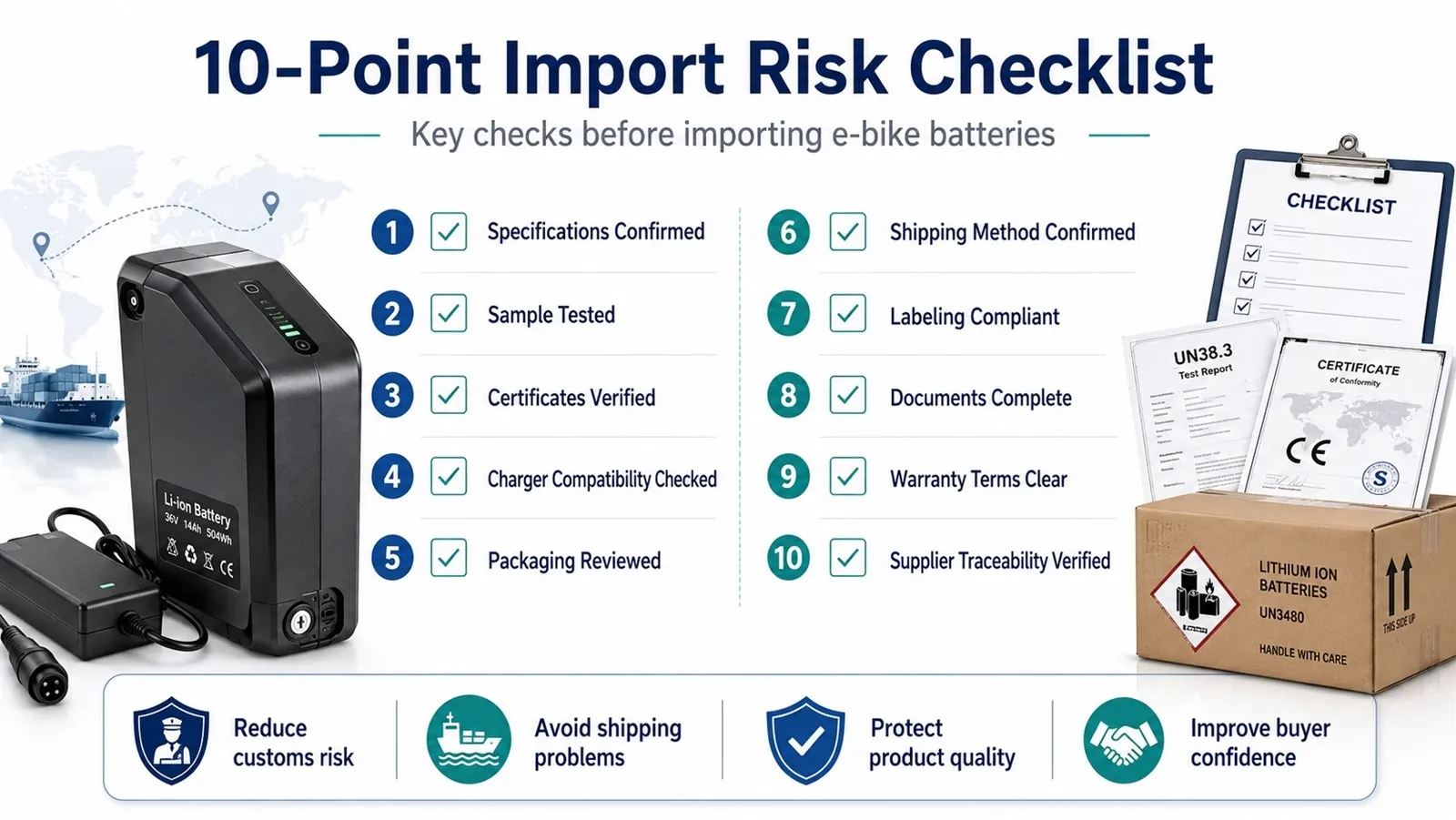
Why Supplier Communication Matters
Good suppliers do not simply say yes to every request. They ask questions, warn about risks, and explain trade-offs. If a requested capacity does not fit safely into a case, a responsible manufacturer should tell you. If a BMS current is too low for a cargo bike, they should recommend a better option.
Communication quality is often a sign of manufacturing quality.
How GEB Helps Buyers Avoid Import Mistakes
GEB supports international B2B customers with e-bike battery specification review, sample development, OEM/ODM customization, bulk production, testing, packaging, and export documentation support. For buyers importing e-bike batteries from China, GEB can help reduce risk by matching battery design with real application requirements.
For e-bike brands and distributors, a reliable battery supplier is not just a product source. It is part of your quality system.
Before placing an overseas e-bike battery order, it is important to confirm whether the product specifications, certification documents, packaging, shipping method, and destination market requirements are aligned. GEB can review your specification sheet and market requirements to help identify avoidable sourcing risks before you commit to an order. Contact GEB here: https://www.gebbattery.com/contact-us
FAQ
Is it safe to import e-bike batteries from China?
Yes, if you work with a professional manufacturer, confirm specifications, test samples, check documents, and use proper shipping methods. The risk increases when buyers choose only by lowest price.
What is the most common sourcing mistake?
The most common mistake is unclear specifications. Voltage and capacity alone are not enough. Motor power, BMS current, case, connector, charger, and target market also matter.
Should I inspect batteries before shipment?
Yes. Pre-shipment inspection helps confirm quantity, appearance, labels, packaging, voltage sampling, and basic function before goods leave the factory.
Can GEB support importers and distributors?
Yes. GEB works with B2B customers on custom e-bike batteries, standard replacement batteries, sample testing, bulk orders, and export support.


