If you are building an e-bike brand or expanding a battery distribution business, you will often hear two terms: OEM and ODM. Both are common in e-bike battery manufacturing, but they mean different things. Choosing the wrong model can lead to wasted development time, higher cost, poor fit, or limited product differentiation.
This guide explains the difference between OEM and ODM e-bike battery manufacturing and helps buyers decide which option is better for their business.

What Is OEM E-Bike Battery Manufacturing?
OEM stands for Original Equipment Manufacturer. In battery procurement, OEM usually means the buyer has specific requirements and the manufacturer produces the battery according to those requirements. The buyer may provide drawings, dimensions, connector specifications, label design, performance targets, or complete technical documents.
OEM is suitable when you already know what you need. For example, your e-bike frame has a fixed battery cavity, your controller requires a specific connector, or your brand needs a battery pack with a defined voltage, current, and communication protocol.
OEM projects often involve more engineering communication because the supplier must match your design accurately.
What Is ODM E-Bike Battery Manufacturing?
ODM stands for Original Design Manufacturer. In this model, the manufacturer already has existing designs, platforms, cases, or technical solutions. The buyer can select a ready platform and customize certain details such as logo, label, capacity, connector, packaging, or color.
ODM is suitable when you want faster development and lower risk. Instead of designing everything from zero, you use a battery platform that has already been tested and produced.
For many distributors and new e-bike brands, ODM is the more practical starting point.
Key Differences Between OEM and ODM
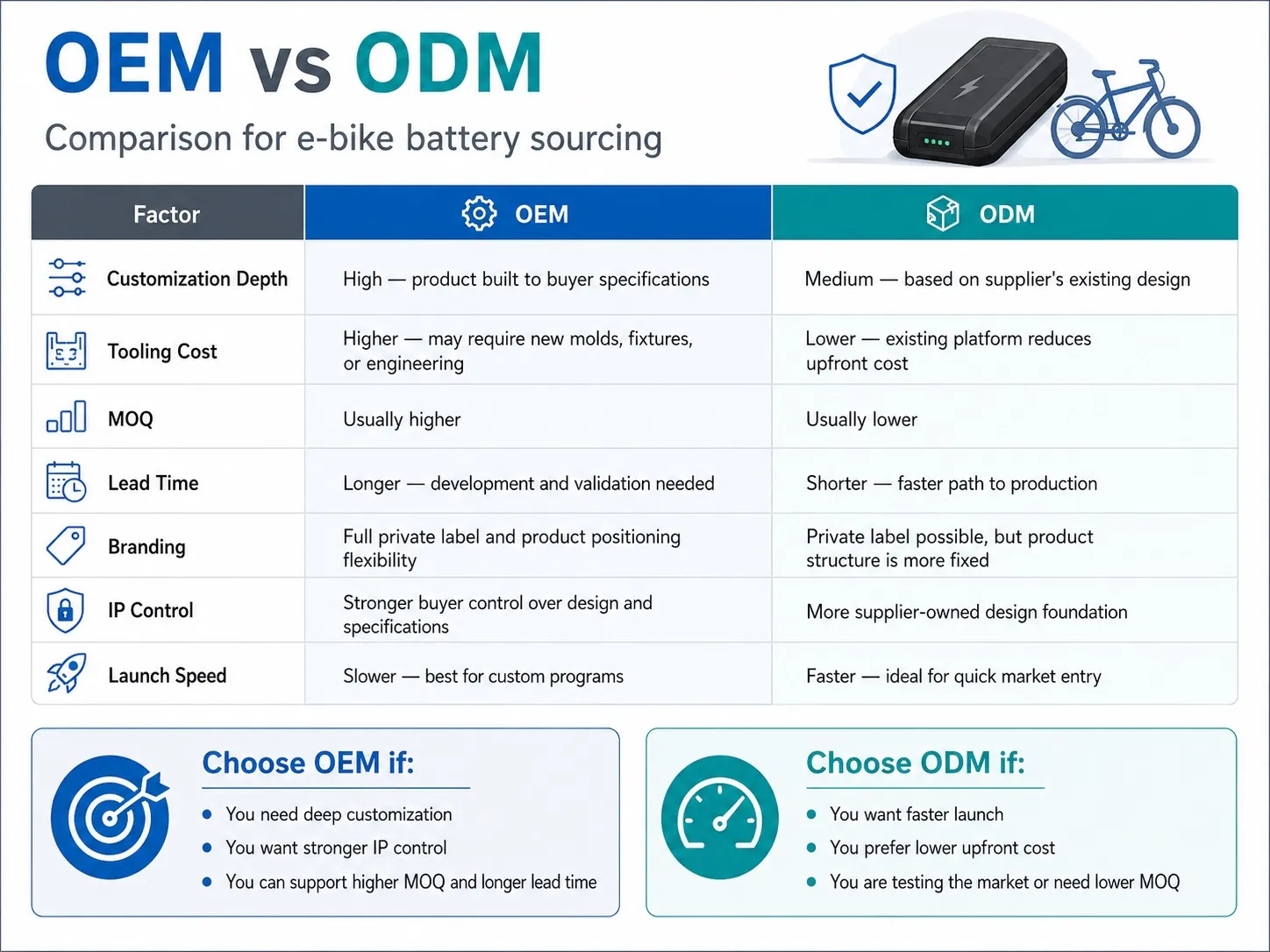
OEM gives more control, while ODM gives more speed. OEM may create stronger brand differentiation, but it usually requires more engineering work, higher MOQ, and longer lead time. ODM may not be fully unique, but it is often faster, more cost-effective, and easier for trial orders.
In e-bike battery manufacturing, the difference is not always strict. Many projects are semi-custom: the supplier uses an existing case and battery structure, while customizing capacity, connector, BMS, label, and packaging for the buyer.
When OEM Is the Better Choice
Choose OEM if your project has special requirements that cannot be solved by a standard battery platform.
OEM is usually better when:
- You have a unique e-bike frame design
- The battery must fit a private mold cavity
- You need a special communication protocol
- You require a specific discharge current profile
- The battery must match a proprietary controller or display
- You need exclusive appearance or structure
- You plan long-term high-volume production
- Your brand differentiation depends on battery design
OEM can give your product stronger uniqueness. However, it also requires clear technical documents and a more patient development process.
When ODM Is the Better Choice
Choose ODM when speed, reliability, and cost control are more important than complete uniqueness.
ODM is usually better when:
- You need to launch quickly
- You are testing a new market
- Your quantity is not large enough for new tooling
- Standard battery cases already meet your needs
- You want lower development cost
- You prefer a proven design
- You need private label but not a new structure
For example, many brands start with a proven downtube battery, rear rack battery, or triangle battery platform. They customize the label, capacity, connector, and packaging, then move to deeper customization after the market grows.
Important Technical Items in Both OEM and ODM Projects
Whether you choose OEM or ODM, the following technical points must be confirmed:
- Voltage and capacity
- Cell type and configuration
- Continuous and peak discharge current
- BMS protection functions
- Charging voltage and current
- Case dimensions and mounting method
- Connector type and cable length
- Waterproof and vibration protection
- Charger compatibility
- Certification requirements
- Label and manual content
- Packaging and shipping method
Do not assume that ODM means no technical work. Even a standard battery must be matched to your e-bike system correctly.
Cost Differences Between OEM and ODM
Related guide: How to Compare E-Bike Battery Quotations.
OEM usually costs more at the beginning because it may require design work, sample development, tooling, custom BMS, testing, and more engineering time. The unit price may become competitive later if volume is high.
ODM usually has lower development cost because the supplier has already completed much of the design work. The buyer can focus on customization and market launch.
However, the lowest development cost is not always the best choice. If the ODM platform does not fit your bike well, the savings can disappear through returns, poor reviews, and compatibility complaints.
MOQ and Lead Time Differences
Related guide: E-Bike Battery Lead Time.
OEM projects usually require higher MOQ and longer lead time. The supplier may need to order special materials, open tooling, design fixtures, test prototypes, and adjust production flow.
ODM projects usually have more flexible MOQ and shorter lead time because the platform is already available. For standard models, the supplier may only need to adjust capacity, connector, label, and packaging.
A practical approach is to start with ODM when testing a market, then move toward OEM once your sales volume and product direction are stable.
Branding: Private Label vs Real Customization
Many buyers say they want OEM, but they actually need private label. Private label means the battery is based on an existing supplier model but carries your logo, label, packaging, and sometimes custom color. This is closer to ODM or semi-custom manufacturing.
Real OEM means deeper engineering customization. It may include a unique case, custom BMS logic, exclusive mechanical design, or a structure designed around your frame.
Understanding this difference helps avoid confusion during quotation.
How to Choose the Right Manufacturing Model
Ask yourself these questions:
- Do we already have a battery drawing?
- Does our e-bike frame require a unique battery shape?
- Is our order volume large enough for tooling?
- Do we need fast market launch?
- Is brand differentiation based on battery appearance?
- Do we need special communication with the controller?
- Is this a trial project or a long-term product line?
If you need speed and lower risk, start with ODM. If you need a unique product and have enough volume, OEM may be the better path.
How GEB Supports OEM and ODM E-Bike Battery Projects
GEB supports both OEM and ODM e-bike battery manufacturing for B2B customers. For ODM projects, GEB can provide existing battery platforms and customize capacity, connectors, BMS, labels, and packaging. For OEM projects, GEB can work with buyers on voltage, dimensions, structure, discharge current, BMS function, and application-specific requirements.
Whether you are an e-bike brand, distributor, repair chain, or importer, the right manufacturing model should match your product stage, budget, and market plan.
Choosing between OEM and ODM depends on your product drawings, target price, customization needs, and launch schedule. If you are not sure which development path is better for your e-bike battery brand, GEB can review your project details and recommend a suitable path before sample development. Contact GEB here: https://www.gebbattery.com/contact-us
FAQ
Is OEM always better than ODM?
No. OEM gives more control but takes more time and cost. ODM is often better for faster launch, smaller trial orders, and proven battery platforms.
Can I put my brand on an ODM e-bike battery?
Yes. Many ODM projects support private labels, custom stickers, packaging, manuals, and sometimes case color changes.
When should I choose a fully custom OEM battery?
Choose OEM when your frame, controller, connector, communication protocol, discharge current, or branding requires a unique design that standard platforms cannot satisfy.
Can GEB support both OEM and ODM?
Yes. GEB provides OEM/ODM e-bike battery solutions for B2B customers, including standard platforms, semi-custom projects, and fully customized battery pack development.